


Analyzing Filter Winding Machine Applications in Water Treatment
A filter winding machine sits at the centre of string wound filter cartridge production for many water systems. These machines build cartridges for three headline duties: pre-filtration, reverse osmosis pre-treatment, and industrial water treatment.
Buyers face a crowded field of filtration choices. Where exactly do winder-produced string wound filters fit? How should a team judge them on performance, compliance, and cost? Depth-style string wound filters are well suited to sediment filtration and general water filtration, yet pleated and membrane options serve other niches. This analysis explains the winding principle, maps real applications, compares alternatives on like-for-like terms, and offers practical selection and cost guidance.
Key Takeaways
Filter winding machines build string wound cartridges for pre-filtration, reverse osmosis pre-treatment, and industrial water treatment.
Tension control shapes the depth structure of the cartridge, and that structure determines particle capture and service life.
String wound cartridges suit sediment removal and protect downstream equipment such as membranes and carbon filters.
For reverse osmosis pre-treatment, a 1–5 μm wound element is the usual range, with 5 μm the most widely specified single rating.
Wound cartridges combine high dirt-holding capacity with low unit cost, which suits sediment-heavy water.
Pleated and membrane filters provide absolute ratings and sterile duty; wound cartridges do not.
When selecting a machine, check spindle count, cartridge size range, and yarn compatibility.
Evaluate total cost across cartridge price, service life, changeout labour, and downtime risk.
How a Filter Winding Machine Works
Core Winding Principle
Media feed and tension control
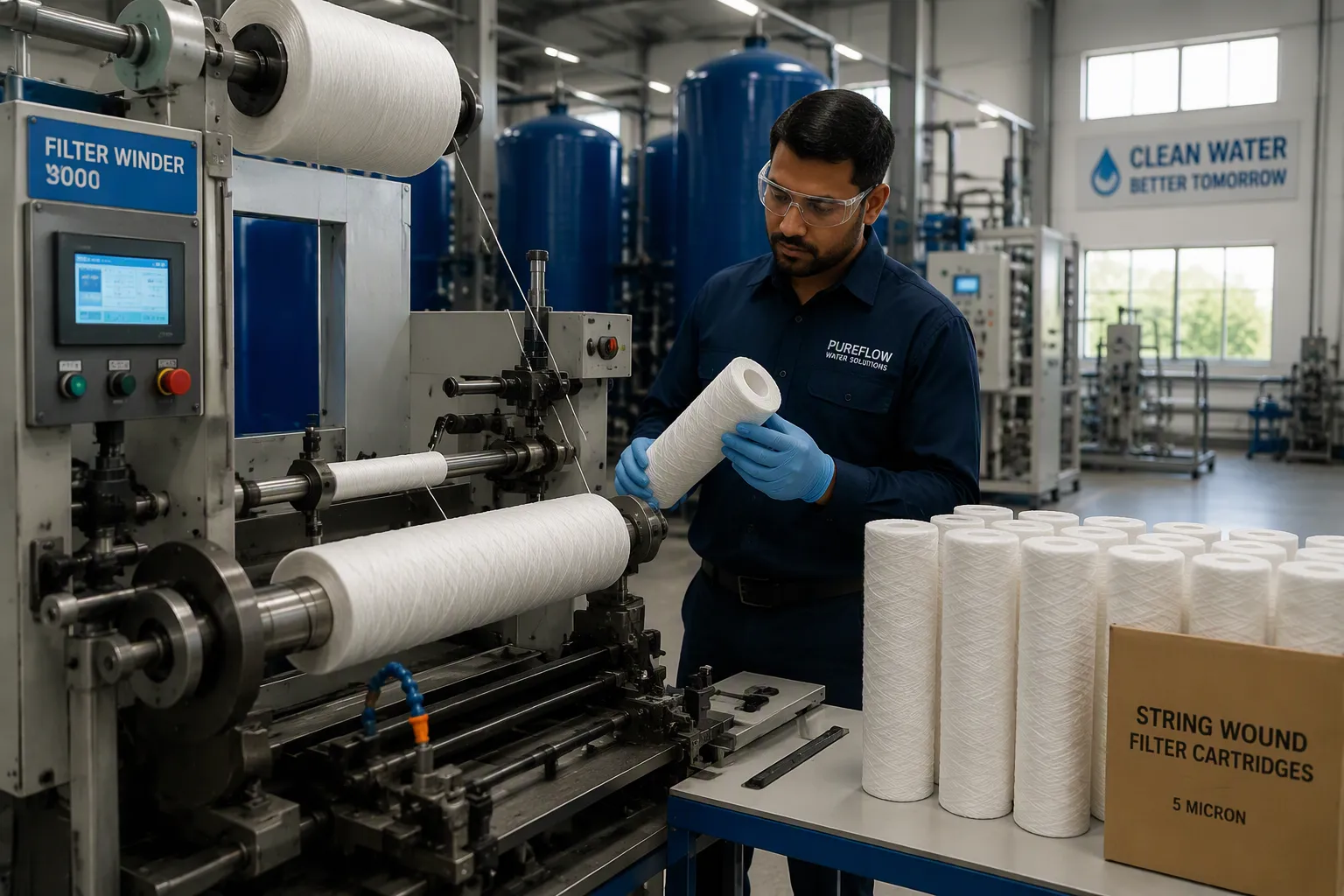
A filter winding machine feeds filter media from a spool and wraps it around a rotating core. The media may be PP yarn, absorbent cotton, or fiberglass. Tension control governs the result. Too much tension crushes the structure and shortens cartridge life. Too little tension leaves soft layers that shed dirt under pressure swings.
The ZHISHUOFilter Cartridge Winding Machine illustrates the engineering involved. A closed-loop constant tension control system holds the yarn steady through the full wrap cycle. An electronic gear synchronisation algorithm keeps chuck rotation and guide movement in step. Diameter taper compensation and S-curve soft start adjust torque as the roll grows, so layers build evenly.
Spiral winding around a porous core
The guide travels laterally as the core spins, laying yarn in a controlled spiral. Programmed tension curves and electronic cam control build an inner-tight, outer-loose depth structure. Coarse particles stop in the open outer layers; finer particles travel deeper before capture. This graded design raises dirt-holding capacity without a corresponding rise in initial pressure drop.
From Machine to Finished Cartridge
Cartridge dimensions and micron ratings
Commercial machines produce string wound cartridges with adjustable winding diameters from 45 to 200 mm and coil widths from 70 to 120 mm, depending on model. Spindle configurations use synchronised variable-speed winding, with rolling speed adjustable to the current coil diameter. Wound elements typically cover a 1–100 μm nominal range. Dirt-holding capacity varies with media, rating, and flow rate, so it should be compared on the same test basis rather than from catalogue maxima.
Quality checks during production
Single-spindle independent control lets each station stop automatically at full length. Auto-alarms flag thread breaks or missing cores. Factory trial runs with production elements verify mechanical alignment and tension stability before shipment.
Why Winding Precision Matters
Depth filtration and dirt-holding capacity
Precision winding creates a graded honeycomb structure, open at the surface and dense near the core. A structure of this kind typically shows pore openings in the tens of microns at the outer surface and single-digit microns close to the core, so particles are captured progressively through the wall rather than at a single plane. Retention is nominal: wound cartridges are rated by the micron size at which a stated proportion of challenge particles is retained, not by an absolute pore size. Clean pressure drop commonly falls in the 0.02–0.1 MPa range, and flow per 10-inch element typically runs between 0.5 and 2.5 m³/h depending on rating and fluid viscosity.
Consistency across production runs
Uniform yarn diameter, bulk, and tension prevent oversized flow channels and premature bypass. A stable yarn structure resists particle unloading and extends usable life. Tension control, density grading, and yarn quality have to work together; a precise pattern cannot compensate for inconsistent raw material.
Matching Cartridges to Your Winder?
Send the cartridge length, diameter, core type, and required micron rating. The response covers yarn options, tension settings, and expected service life for the duty.
Get a QuoteView Winding MachinesKey Applications in Water Treatment
Pre-Filtration for Municipal and Process Water
Protecting downstream equipment
String wound cartridges serve as a first-stage barrier in many water systems. Their depth structure traps large particles near the outer layers and finer particles deeper inside. This design shields carbon filters, softeners, UV units, and membranes from sediment loading. Municipal plants use this stage to remove sediment, sand, and rust before downstream treatment begins. The same logic applies in process water lines, where a clogged downstream unit means lost production time.
Industrial cartridge filters, including string wound, melt blown, and pleated types, are built to remove particulates and suspended solids from process water and fluids. They are specified for dirt-holding capacity, filtration efficiency, and service life, which together set maintenance intervals and help operators meet water quality targets.
Sediment and particulate removal
A string wound sediment filter handles sand, dirt, rust, silt, and suspended solids across residential, commercial, and industrial settings. Households on well water favour these cartridges where sediment loads are heavy. The wound media, polypropylene, glass fibre, or cotton, wraps around a stainless steel or polypropylene core. Municipal drinking water pre-treatment also depends on this format, particularly where source water carries high sediment loads.
| Application in Municipal Plants | Role | Context |
|---|---|---|
| Pre-filtration stage | Removes sediment, sand, and rust | Protects membranes and equipment from fouling |
| Drinking water pre-treatment | Initial particulate removal | Relied on where source water has high sediment loads |
| General sediment capture | Removes rust, dirt, and sediments | Fibre media wound on a steel or plastic core |
Reverse Osmosis Pre-Treatment
Safeguarding RO membranes
Reverse osmosis systems need clean feed water. String wound polypropylene elements capture suspended solids ahead of the membrane, which lowers fouling risk. A 1–5 μm rating is the usual range for this duty, and 5 μm is the most widely specified single rating. Operators commonly install a 5 μm wound pre-filter ahead of the RO skid to catch particles of mixed size.
Silt density index control
Silt density index measures how quickly particulates plug a test membrane, and the measurement itself is defined in the standard test method for silt density index of water[1]. Most RO membrane manufacturers require SDI below 5, and many specify below 3 for spiral-wound elements. A fine wound element rated between 1 and 5 μm removes enough suspended solids to bring SDI into that range. Because wound cartridges cover a broad spread of ratings and materials, operators can match the element to feed water conditions and hold SDI steady across seasonal swings.
Industrial Water Filtration Systems
Cooling water and boiler feed
Industrial water filtration systems vary by duty, and wound elements appear across several of them:
Boiler feedwater pre-filtration: removes suspended solids, limits deposit formation, and supports stable boiler operation.
Cooling water filtration: captures sediment, rust, and grit in cooling towers and circulating systems, protecting heat-exchange surfaces.
Condensate recovery: removes impurities in power plant condensate, maintaining water purity and limiting corrosion risk.
A 25–50 μm rating suits most industrial cooling duties, where the objective is equipment protection rather than fine clarification.
Food, beverage, and pharmaceutical lines
| Sector | Described Use |
|---|---|
| Food and beverage | Clarifying potable drinks to maintain product quality and meet health standards |
| Food processing lines | String wound water filters for predictable performance and compliance |
| General processing | Specified where efficiency and low maintenance matter most |
| Pharmaceutical | Pre-filtration ahead of purified-water and 0.2 μm membrane stages |
These industries specify wound cartridges for predictable performance and low maintenance. Sterile filtration itself remains a membrane duty: pharmaceutical water systems use 0.2 μm membrane filters for microbial retention, while wound cartridges handle the 1–10 μm pre-filtration ahead of them.
Demand for string wound cartridges concentrates in water treatment. One 2025 market study puts the application share at 42% for water treatment and purification, 31% for industrial process filtration, 15% for oil and gas, and 12% for food and beverage, with polypropylene the dominant media. Shares of this kind are estimates from a single research source and differ between studies, but the ranking matches the duty profile described above: wound elements do most of their work upstream, where sediment loads are highest.
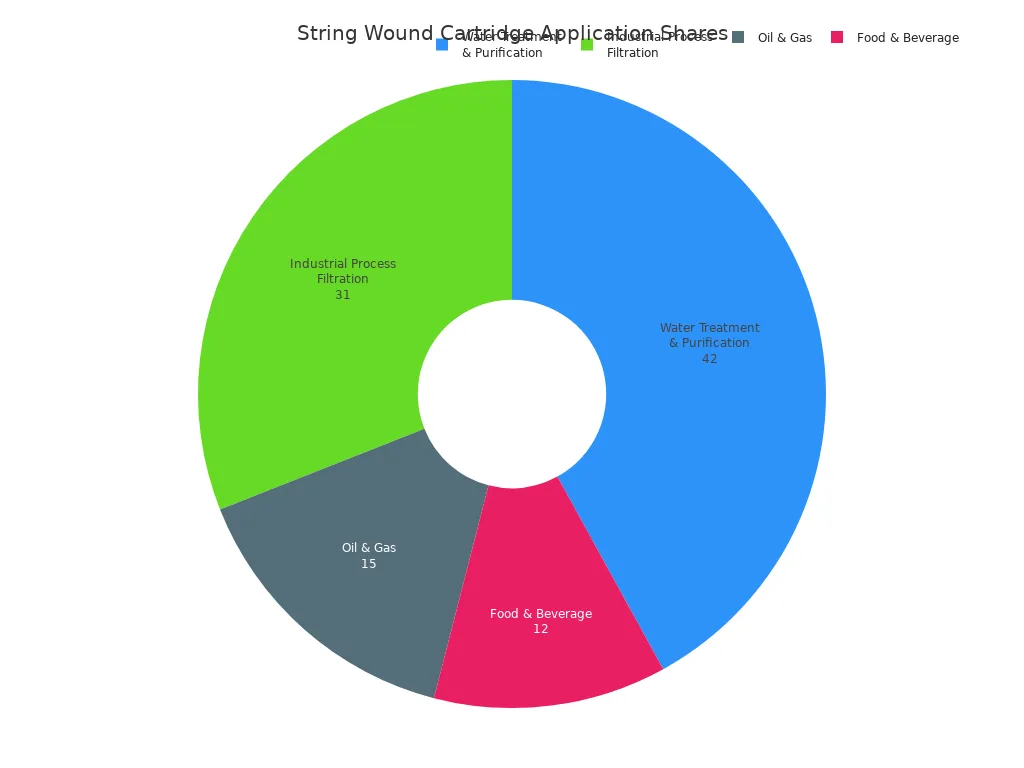
Because wound cartridges protect RO and ultrafiltration membranes from sediment loading, the economics of a treatment train depend on how well the pre-filtration stage is matched to the feed water. Undersized or badly wound elements shift cost downstream, where membrane replacement is far more expensive than cartridge replacement.
Filter Winding Machines vs. Alternatives
Technical Performance Comparison
Pleated filters versus wound cartridges
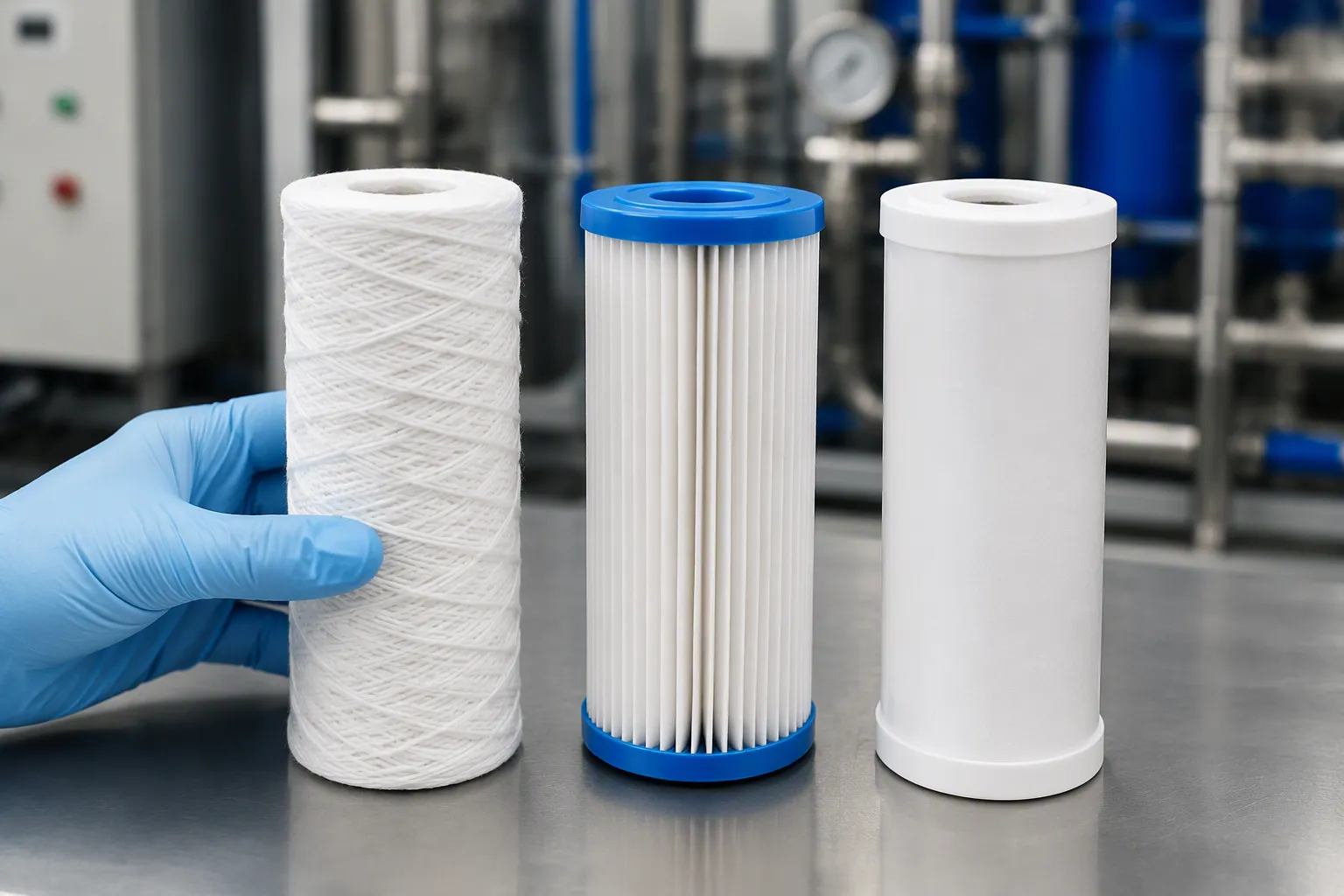
Each format solves a different problem. A string wound filter cartridge builds a graded depth structure. Particles enter the open outer layers and stop progressively deeper inside. This design delivers high dirt-holding capacity and tolerates sediment-heavy water without rapid plugging. Pleated membrane filter cartridges offer a defined pore size and a large surface area in a compact housing. They suit high-flow duties and applications that demand an absolute micron rating. A plant that needs to remove a defined particle size at a stated efficiency will favour pleated construction. A plant that needs to absorb heavy silt loads at low cost will favour wound construction.
Membrane filters and application fit
Membrane filter cartridges provide the tightest control over retention. Sterile pharmaceutical lines, final polish steps, and high-purity water loops depend on them. Their narrow pore distribution justifies the higher unit price in those roles. Wound cartridges rarely compete in that space. They serve upstream instead, where depth filtration removes the bulk load and extends the life of the membrane stage behind them. This staging logic explains why many industrial water filtration systems combine all three formats in series rather than choosing one.
Regulatory Compliance Considerations
Material and potable-water standards
Compliance starts with the media. Polypropylene intended for potable water is normally specified against the food-contact regulation for olefin polymers, 21 CFR 177.1520[2], and cartridges for municipal duty are certified to NSF/ANSI 42 for aesthetic effects, 61 for system components, and 372 for lead content. Bleached cotton used in potable and beverage service is supplied in food-contact grade. Certification attaches to the finished product, so buyers should request the certificate that names the actual cartridge model rather than the media alone.
| Material | Potable-Water / Material Standard | Notes |
|---|---|---|
| Bleached cotton | Food-contact grade | Suitable for potable water, food and beverage |
| Polypropylene (FDA grade) | 21 CFR 177.1520 | Potable water and food/beverage liquids |
| Polypropylene (certifiable) | NSF/ANSI 42/61 | Certifiable content and traceability |
| Municipal string filters | NSF/ANSI 42/61/372 | Tested and certified; controlled wetted parts |
Drinking-water quality requirements sit with the regulator, not the cartridge. The national primary drinking water regulations[3] set the contaminant limits a municipal plant must meet, and pre-filtration supports compliance rather than demonstrating it.
Documentation for regulated industries
Regulated buyers rarely accept a cartridge on trust. They request a Certificate of Conformity, EN 10204 3.1 material test certificates for SS304 or SS316 cores, and declarations of conformity for CE marking, including the Pressure Equipment Directive where the housing falls in scope. Batch traceability and inspection records complete the package. Equipment builders support these requests through documented manufacturing. The manufacturer states CE marking and ISO 9001 / ISO 14001 certification, which gives buyers a documented quality baseline when they assemble a compliance file.
Cost and Lifecycle Comparison
Upfront equipment and cartridge costs
A filter winding machine represents capital investment, yet it lets a producer control cartridge supply, lead time, and specification. On the consumable side, wound cartridges carry a comparatively low unit cost, which suits less demanding duties. Cartridges typically cost more per unit of treated flow than filter bags, largely because several cartridges are needed to match one bag's capacity. Pleated and membrane formats cost more again, and the premium reflects tighter pore control rather than media volume.
Changeout frequency and total cost of ownership
Purchase price alone misleads. A 100 GPM duty may need five 30-inch cartridges where a single #2 size filter bag would serve, and that multiplies disposal volume. Cartridge changeout also takes longer than bag changeout, since it involves washers, nuts, and sealing plates; ten minutes per housing is a common planning figure. Across several housings that accumulates over a year. Sound procurement therefore compares price per cartridge, service life, replacement frequency, maintenance labour, shipping and lead time, spare-parts inventory, and downtime risk. Wound cartridges have a graded rather than a defined pore structure and are rated nominally, so they belong in pre-filtration, where they protect costlier downstream stages.
Building a Pre-Filtration Specification?
Share the feed water analysis, target SDI, and downstream membrane model. The comparison covers wound, pleated, and membrane staging against the same duty.
Contact UsView Product RangeSelection Criteria and Cost Considerations
Matching the Machine to Your Application
Throughput and cartridge size requirements
Spindle count sets output. A two-spindle unit winds two elements at once, and a three-spindle option raises daily volume for busier lines. Length and diameter ranges decide which orders a machine can accept.
| Parameter | Typical Specification |
|---|---|
| Spindle count | 2 spindles; 3-spindle option available |
| Cartridge length range | 5" to 70" (127–1778 mm) |
| Winding core diameter | 28 mm |
| Winding outer diameter | 45 mm to 200 mm |
| Micron rating range | 0.5 µm to 100 µm |
| Core materials | Polypropylene, stainless steel, tinned steel |
| Yarn materials | PP yarn, cotton yarn |
A plant serving drinking water accounts needs a narrower band than a plant supplying petroleum or chemical clients. Buyers should list every size they plan to sell before comparing models.

Large Flow Winding Machine
High-output winding for long cartridges and continuous production lines.
View Product
String Wound Filter Machine
Vertical winding platform for PP, cotton, and glass fibre elements.
View Product
Small Flow Winding Machine
Compact two-spindle unit for short runs and small-diameter cartridges.
View ProductMedia compatibility and micron range
Polypropylene yarn covers ratings of 1, 5, 10, 20, 25, 30, 50, 75, and 100 μm. Bleached cotton, usually paired with a stainless core, spans a similar range. Glass fibre yarn is available where higher temperature resistance is needed, though polypropylene and cotton dominate water treatment. Tension and pitch settings have to change with the media, so buyers should confirm yarn support against the actual product mix.
Choosing a Filter Winding Machine Manufacturer
Questions to ask before purchase
A short list of questions separates serious suppliers from catalogue sellers:
Which filter sizes can the machine handle, across the full model range?
Which yarns does it support, and can tension and pitch change per material?
What production speed, automation level, and testing procedure apply?
Which changes are standard, which are optional, and can the unit run on local voltage?
What documentation ships with the machine, and how does installation support work?
Can the supplier trial the unit with your own elements before shipment?
At minimum, the supplier should know the filter diameter and the length that needs to be wound.
Warranty, support, and spare parts
Warranty terms, after-sales response, and spare-part availability carry real weight over a machine's service life. A filter winding machine manufacturer such as ZHISHUO states OEM/ODM customisation, CE marking and ISO certification, a one-year warranty, free wearing parts, and operator training. Buyers should also confirm MOQ flexibility for trial orders, sample availability, payment terms, and delivery timelines.
Budgeting for Long-Term Operation
Consumables and maintenance planning
Yarn, cores, and wearing parts form the recurring cost base. A maintenance calendar built around spindle checks and tension calibration prevents unplanned stops. Spare-part stock levels should match the changeout rhythm the plant actually observes.
Scaling production as demand grows
Modular spindle configurations let a producer add capacity without replacing the whole line. Planning floor space and power supply for future units early avoids costly retrofits later.
Conclusion
Filter winding machines underpin pre-filtration, RO pre-treatment, and industrial water treatment. They produce consistent string wound filter cartridges, and that consistency decides how well each element performs in service.
The comparison offers a clear takeaway. Wound cartridges deliver strong dirt-holding capacity and cost efficiency in sediment filtration. Pleated and membrane options fit other niches, such as absolute ratings and sterile duty. The right choice depends on the application.
Plants that run industrial water filtration systems need a dependable string wound sediment filter supply. Buyers seeking a reliable filter winding machine manufacturer can consider ZHISHUO for equipment, cartridges, and support. Careful planning around the pre-filtration stage pays off across every stage that follows.
Need a Machine Specification Before Budgeting?
Submit the cartridge sizes, yarn types, and output target. The reply covers spindle configuration, footprint, power supply, and lead time.
Get a QuoteView String Wound MachinesFAQ
What does a filter winding machine produce?
It winds PP yarn, absorbent cotton, or glass fibre around a porous core. The result is a depth-style string wound filter with graded density, used for sediment removal in many water systems.
Which cartridge sizes can one machine make?
Typical models cover winding diameters from 45 to 200 mm and coil widths from 70 to 120 mm, with cartridge lengths from 5" to 70" on the larger frames. Buyers should confirm the size range against every product they plan to sell.
Where do wound cartridges fit in a treatment train?
They work as the first stage. The depth structure captures sand, silt, and rust before finer treatment steps, which protects membranes and extends the life of costlier stages downstream.
Can wound elements support reverse osmosis systems?
Yes. A rating between 1 and 5 μm removes enough suspended solids to bring silt density index below 5, which most RO membrane manufacturers require. Operators match the rating to feed water conditions, and many specify 5 μm as the working value.
How does winding quality affect performance?
Even tension builds the inner-tight, outer-loose structure that traps particles progressively. Loose layers shed dirt under pressure swings. Consistent winding keeps pressure drop low and service life predictable.
What should buyers check before ordering a machine?
Ask which yarns and sizes the unit supports, how tension changes per material, and what testing precedes shipment. Trial runs with the buyer's own elements reveal real performance.
What support comes with the equipment?
The manufacturer states a one-year warranty, free wearing parts, and operator training, together with OEM/ODM customisation and CE and ISO certification. Buyers should confirm spare-part availability and response times in writing.
How do buyers evaluate total cost?
Compare price per cartridge, service life, changeout labour, and downtime risk. A low unit price means little if changeouts run frequently. Wound elements suit sediment-heavy water where cost efficiency matters most.
References and Notes
ASTM D4189, Standard Test Method for Silt Density Index (SDI) of Water — astm.org/d4189-07r14.html
21 CFR 177.1520, Olefin polymers, US Code of Federal Regulations — ecfr.gov — 21 CFR 177.1520
US Environmental Protection Agency, National Primary Drinking Water Regulations — epa.gov — drinking water regulations
Standards referred to in the text but not linked here include NSF/ANSI 42, NSF/ANSI 61, NSF/ANSI 372, EN 10204, and the Pressure Equipment Directive. Machine specifications in Table 4 are typical values from the manufacturer and vary by model.


