


Essential Machines for Air Filter Manufacturing: A Comprehensive List
Air filter manufacturing relies on a core set of machines to turn raw media into finished products. These include the pleating machine, gluing machine, cutting machine, assembly line, testing equipment, and supporting tools. Each plays a distinct role in the production process.
This article offers a comprehensive, practical list of air filter manufacturing equipment. It helps readers plan purchases or design a production line. The importance of air filtration makes efficiency and performance critical. Whether someone is new to manufacturing or expanding existing systems, this guide provides clear, actionable information for building reliable air filtration systems.
Key Takeaways
Select a pleating machine based on your production volume and media type: rotary for high speed, reciprocating for stiff media.
Control glue temperature and viscosity precisely to ensure consistent bond strength and avoid nozzle clogging.
Choose between pneumatic and servo end cap welders: servo offers higher precision and flexibility for advanced filters.
Use cutting, winding, and extension machines to transform media into ready-for-assembly components reliably.
Automated assembly lines with buffer zones boost throughput by 15–30% and reduce stoppages by 50–70%.
Test filters for pressure drop and efficiency to meet ISO, ASHRAE, or EN standards and avoid defects.
Integrate material handling tools and dust collection to maintain clean production and smooth workflow.
Core Air Filter Manufacturing Equipment
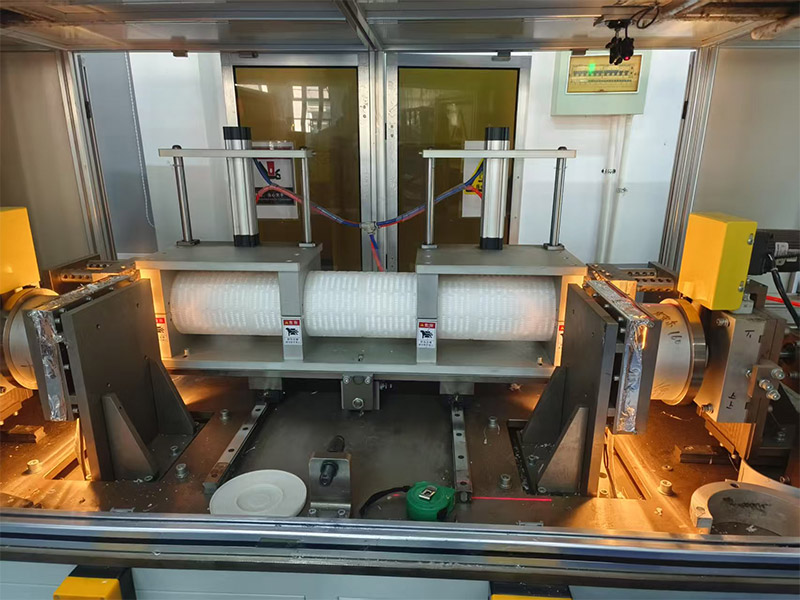
Three production machines form the backbone of most air filter manufacturing lines. The pleating machine, gluing machine, and end cap welding machine transform raw media into functional filter elements. Each piece of equipment performs a specific task that affects final product quality. Understanding these core machines helps manufacturers plan equipment investments and production planning with confidence.
Pleating Machine
Function and Working Principle
The pleating machine folds flat filter media into uniform, accordion-like pleats. This process increases the surface area within a given frame size. Standard pleating machines handle a variety of media types including polyester, cotton-polyester blends, synthetic microfibers, and paper-based cellulose. The machine feeds media from a roll, scores it at precise intervals, and compresses the folds into a compact structure. Material selection directly influences the pleating parameters. Thicker media requires wider pleat spacing. Softer media needs gentler handling to prevent tearing.
Types and Key Specifications
Two main pleating machine designs dominate the industry. Rotary pleaters use continuous rotary motion to achieve significantly higher production speeds. Reciprocating pleaters use a blade that moves back and forth to create each fold. This design produces sharp, precise pleats ideal for stiff media types.
| Metric | Rotary Pleating Machine | Reciprocating Pleating Machine |
|---|---|---|
| Output Speed | Up to 50 meters per minute; up to 3× faster | Slower; each pleat requires a blade return stroke |
| Pleat Height Consistency | Advanced servo motor controls maintain precise depth and spacing | Consistent for stiff media |
| Material Suitability | Better for softer, continuous media rolls | Ideal for stiff media requiring sharp pleats |
Manufacturers choose between these types based on production volume and filter design. Rotary machines suit high-volume air filter manufacturing where speed drives efficiency. Reciprocating machines remain valuable for specialized filter designs that demand precise folding of rigid materials.
Gluing Machine
Adhesive Application Methods
Gluing machines apply adhesive to pleated media tips or frame surfaces. The choice between hot-melt and cold glue systems depends on production speed, material compatibility, and bond strength requirements. Hot-melt adhesives solidify quickly, enabling faster line speeds. Cold glue systems use water-based or solvent-based adhesives that require longer curing times.
Three primary application methods exist for filter manufacturing.
| Application Method | Optimal Viscosity (mPa·s) | Application Temperature | Line Speed Range |
|---|---|---|---|
| Slot Die Coating | 1,000 – 8,000 | 140 – 170 °C | 50 – 500 m/min |
| Spiral Spray | 2,000 – 6,000 | 150 – 170 °C | 30 – 200 m/min |
| Bead / Dot | 3,000 – 15,000 | 160 – 180 °C | 20 – 200 m/min |
Spiral spray works well for HEPA media because it avoids direct contact with the substrate. It covers complex three-dimensional geometries such as pleat tips without damaging the delicate fibers. Slot die coating applies a uniform film across the media width. Bead or dot application deposits adhesive at discrete spots along the pleats.
Critical Settings and Controls
Equipment operators must control glue temperature and flow rate precisely. Design considerations include viscosity ranges for each method. Viscosity below the optimal range causes dripping and stringing. Viscosity above the range can clog nozzles or produce weak bonds. Nozzle patterns require verification every six months to prevent uneven application. Temperature fluctuations directly affect adhesive performance and final seal quality. Maintaining stable temperature ensures consistent bond strength across production runs.
End Cap Welding Machine
Hot Plate Welding Technology
End cap welding machines attach plastic end caps to filter cartridges without adhesives. Hot plate welding technology uses a heated platen coated with PTFE to melt the end cap surfaces. The process involves four sequential steps. First, the platen heats the surfaces and creates a controlled melt layer. Second, the platen retracts quickly, leaving two molten interfaces exposed. Third, the molten surfaces press together under controlled force, allowing polymer chains from both parts to interdiffuse across the interface. Fourth, the joint cools under pressure until it solidifies. This forms a monolithic, hermetic bond that matches the strength of the parent material. The process works effectively with PP, PES, and PMMA end caps.
Pneumatic vs. Servo Models
Filter manufacturers choose between pneumatic and servo end cap welders. Pneumatic models offer a cost-effective solution for standard systems with consistent specifications. Servo-driven models provide significantly higher position repeatability. Servo systems achieve ±0.01–0.05 mm precision compared to ±0.1–0.3 mm for pneumatic systems. This represents a more than three times improvement in accuracy. Servo systems typically cost 25–40% more than pneumatic baselines. However, they offer fully programmable force and speed profiles. Operators can switch between products with one key press instead of manual adjustment. For advanced air filter customization, servo-driven machines provide greater flexibility. For budget-sensitive runs, pneumatic models deliver reliable results.
ZHISHUO's Filter Cartridge End Cap Welding Machine line includes both pneumatic and servo-driven configurations. The Large Flow Pneumatic model suits economical operations with cycle times of 35–45 seconds per piece. The Large Flow Servo models accommodate filters up to 40 inches in length and weld PP, PES, and PMMA end caps with adhesive-free, leak-proof sealing. These machines support manufacturing liquid pleated filter elements, high-flow filters, and various industrial filtration products. The equipment enhances productivity and reduces waste while achieving superior weld integrity for air filtration systems. Standards compliance ensures these machines meet international quality requirements.
Air Filter Manufacturing Workflow
After core machines complete pleating and end cap welding, the next stage prepares media for final assembly. Three types of air filter manufacturing equipment—cutting, winding, and extension—transform media into ready-for-assembly components. This workflow ensures consistent sizing and structural integrity. The broad process progresses from media inspection through pleating, cutting, assembly, bonding, testing, and packaging. Reliable production machines at this stage determine efficiency and final product quality.
Cutting Machine
The cutting machine processes rolled filter media into precise segments. After pleating, operators feed pleated panels into the machine. The equipment trims material to exact length and width for seamless assembly. Cutting marks the transition from continuous media to discrete filter elements.
Guillotine and Rotary Die Cutters
Two primary cutter designs serve the industry. Guillotine cutters use a straight blade that descends vertically. This design achieves clean edges on thick, rigid media. Rotary die cutters use a cylindrical blade that rolls across the material. Rotary systems provide continuous motion and deliver burr-free cuts on pleated substrates. ZHISHUO's Filter Cartridge Cutting Machine features a 6-blade rotary system with infrared calibration. The double-head configuration allows simultaneous dual-end cutting for higher throughput. An auto-loading hopper and touch screen for length settings further automate the process.
Precision and Safety Features
Precision cutting prevents downstream defects. Inaccurate cuts cause poor end cap fit or unstable bonding. The machine integrates an industrial dust collection system to maintain a clean workspace. Safety features include blade guards, emergency stops, and automatic shutdown upon obstruction. The design protects operators while supporting productivity rates of 80 to 90 pieces per hour in double-head mode.
Winding Machine
The winding machine wraps media around a central core to create depth filtration layers. Materials such as PP yarn and fiberglass produce specific micron ratings. Consistent tension ensures uniform density across the cartridge. The machine creates honeycomb meshes through precise winding. This performance directly affects filter strength and particle retention.
Tension Control and Synchronization
Tension control is the critical parameter in winding operations. Inconsistent tension produces loose windings or collapsed layers. Closed-loop constant tension controls monitor and adjust force in real time. Electronic gear algorithms coordinate spindle rotation with material feed. Diameter taper compensation and S-curve soft start technology prevent sudden tension spikes. ZHISHUO's Filter Cartridge Winding Machine uses closed-loop tension control with electronic cam technology. The equipment adjusts torque dynamically during the winding cycle. Single-spindle independent control with automatic stop for full-length detection reduces waste. Auto alarms alert operators to thread breaks or missing cores.
Spindle Configurations
Spindle count determines production capacity. Configurations with 2 to 6 spindles allow manufacturers to match equipment to volume needs. Machines with two spindles serve low-volume customized runs. Configurations with six spindles support higher output. A single operator can manage multiple spindles through the smart interface.
Extension Machine
The extension machine connects shorter filter elements into longer assemblies. This manufacturing capability is essential for producing ultra-long filters up to 60 inches. The process addresses common challenges like misalignment and weak welds. This stage enables customization through different station configurations.
Coaxial Positioning and Heating
Successful extension depends on perfect alignment and uniform heating. Coaxial dual-positioning fixtures hold both elements in concentric alignment. Contact hot-plate heating melts the end faces uniformly. The two elements press together under controlled force to form a leak-proof bond. ZHISHUO's Filter Cartridge Extension Machine achieves this with a servo motor-driven system and multi-stage closed-loop propulsion. These advanced systems ensure zero-leakage and burr-free fusion. Specialized fixtures adapt to uneven surfaces without damaging the material.
Station Configurations
Manufacturers can choose between single-station and dual-station configurations. Single-station models serve lower-volume runs or high-flow filters. Dual-station machines weld two assemblies simultaneously, doubling output. The dual-station configuration achieves output rates of 160 to 180 pieces per hour for standard filters. Single-station configurations support high-flow models with output rates of 100 to 120 pieces per hour. This modular design considerations approach allows manufacturers to scale production without separate lines.
Cutting, winding, and extension systems transform media into ready-for-assembly components. They prepare the parts for frame insertion, adhesive bonding, and final assembly stations. Coordination across these steps prevents bottlenecks. Reliable performance directly translates to higher yield and consistent filter quality.
Assembly and Bag Production Lines
Assembly lines bring together pleated media, frames, and end caps into finished filters. This step requires careful coordination of air filter manufacturing equipment. Semi-automatic stations and conveyor-based systems both serve the industry. The choice affects throughput and labor needs. Each manufacturer selects the line that matches air filter manufacturing needs.
Assembly Line Configurations
Manual vs. Automated Stations
Manual assembly stations use individual operators. Human pace creates uneven cycle times. Without buffering, the line runs at the speed of the slowest station. Quality checks, tool changes, and material replenishment all cause micro-stops that cascade and reduce output.
Conveyor-based automated lines solve this problem. Accumulation zones decouple adjacent stations. Products queue during delays. Upstream operations continue when downstream stations stop. This approach improves efficiency and reduces waste. The decoupling prevents cascading stoppages across the line. Strategic buffer zones let faster stations run at optimal speed. Buffer size varies by cycle time and pallet travel distances. The right number of pallets makes up for small downtime situations[1].
Make sure you buffer appropriately on nonsynchronous systems. Buffer size varies by cycle time and the distances pallets travel. Rarely should you have less than one pallet waiting at a station. Most of the time, it should be two. Extra pallets will be needed for longer runs. Too many pallets can hurt throughput, but the right amount supports smooth flow.
This decoupling improves throughput by 15–30 percent. Line stoppage frequency drops 50–70 percent. Overall equipment effectiveness scores improve 20–40 percent.
| Performance Metric | Improvement Range |
|---|---|
| Overall throughput increase | 15–30% |
| Line stoppage frequency reduction | 50–70% |
| OEE improvement | 20–40% |
Frame Insertion and Sealing
Frame insertion positions frames around the pleated media. The frame provides structural support for the filter. Sealing stations apply adhesive or fasteners to secure the frame. Proper alignment prevents air bypass around the media edges. This stage directly affects final filter performance.
Filter Bag Production Line
Sewing, Hot-Melt, and Ultrasonic Processes
The filter bag production line combines three joining methods. Sewing creates initial seams that hold the bag shape. Hot-melt adhesive seals longitudinal joints automatically, removing a manual bottleneck. Ultrasonic welding seals bottom seams quickly without thermal damage. Continuous flow eliminates product transfers between separate stations. A two-stage web-guiding system maintains precise material alignment. Servo unwinding with closed-loop tension ensures consistent feed. These production machines require careful synchronization to maintain speed.
ZHISHUO's Filter Bag Production Line integrates these processes. It supports bag diameters from 100 to 200 millimeters. The table below lists how each feature contributes to the rated output.
| Process Feature | Contribution |
|---|---|
| Three-method integration | Eliminates transfers, enables continuous flow |
| Two-stage web-guiding | Prevents deviation stoppages |
| Servo unwinding + tension control | Supports stable high-speed operation |
| Auto hot-melt for longitudinal seams | Removes manual bottlenecks |
| Ultrasonic for bottom seams | Fast, reliable sealing |
| One-operator requirement | Sustains rated output |
Modular Design and Output Rates
Modular design allows quick mold changes. Manufacturers switch bag sizes without lengthy downtime. This flexibility supports advanced air filter customization. The line outputs 4–9 finished bags per minute consistently. One operator manages the entire process. This efficiency suits various production volumes and manufacturing environments.
Role in Air Filtration Systems
Liquid vs. Dust Filter Bags
Finished filter bags serve critical roles in air filtration systems. Liquid filter bags capture particles from water and chemical solutions. Applications include industrial wastewater treatment and process chemical filtration. Dust filter bags remove contaminants from gas streams and exhaust air. Both types support chemical processing, water treatment, and bio-pharmaceutical industries. Multi-stage filtration systems often combine bag types to reach required purity levels. Each stage removes progressively smaller particles.
Material Compatibility
Filter bags use various media materials. PP handles chemical environments and offers good value. PET withstands higher operating temperatures. PTFE delivers maximum chemical resistance for aggressive environments. Standards for material selection depend on the application requirements. Proper material choice ensures bag longevity and consistent performance.
Testing and Supporting Equipment
Testing Equipment
Testing equipment ensures that finished filters meet industry standards before reaching customers. Without rigorous verification, manufacturers risk shipping defective products. Regulatory compliance depends on reliable test data that confirms each filter performs as designed. Standards such as ISO 16890, ASHRAE 52.2, and EN 1822 provide the benchmarks for air filter manufacturing[2]. Meeting government regulations requires documented proof of filter performance.
"It's not about what looks clean. It's about what measures clean."
— Jim Rosenthal, discussing how testing prevents defects and improves product yieldPressure Drop and Efficiency Testing
Two measurements define filter performance: pressure drop and particle capture efficiency. Performance testing follows strict protocols to quantify particle removal by size band using upstream and downstream counts. Pressure drop data connects media selection to airflow resistance and energy tradeoffs[3]. Regulatory compliance relies on accurate measurements that match certified test methods.
Standard HEPA filters start at 1.0–1.35 in. w.g. for new filters at rated airflow. Resistance climbs to approximately 2.0–2.70 in. w.g. at end-of-life. DOE-STD-3020-2015 specifies initial resistance must not exceed 1.0 in. w.g. (250 Pa) for nuclear-grade HEPA filters. EN 1822-1:2019 for H13-grade filters shows initial static pressure drop of ~150–250 Pa[4]. H14-grade filters run higher at ~200–300 Pa.
| Filter Condition | Pressure Drop (in. w.g.) | Pressure Drop (Pa) |
|---|---|---|
| New / Clean | 0.4–1.0 | 100–250 |
| Mid-life | 1.0–1.6 | 250–400 |
| Terminal | 1.5–2.0+ | 375–500+ |
A reading below the rated initial value signals failure rather than good performance. Three causes explain this: filter bypass through seal gaps, media damage like punctures, and non-certified media labeled "HEPA-type" without EN 1822 certification. Both Appendix J of ASHRAE 52.2 and ISO 16890 predict efficiency drops in electret filters during use. Compliance with these standards prevents defects related to degradation over time.
Bench-Top vs. Inline Testers
Bench-top testers evaluate samples in a controlled lab environment. These units suit product development and quality assurance. Inline testers integrate directly into the production line. Inline systems catch defects immediately before packaging. This approach reduces waste and prevents non-compliant products from reaching customers. Compliance with health and safety regulations requires consistent testing throughout manufacturing processes.
Material Handling Tools
Supporting equipment keeps air filtration systems running smoothly. These tools maintain workflow and protect product quality. They also help meet production targets with consistent results.
Rollers, Unwinders, and Conveyors
Rollers guide filter media from storage rolls into production lines. Unwinders feed material at controlled tension to prevent stretching or tearing. Conveyors transport partially assembled filters between stations. Proper speed matching prevents bottlenecks.
Dust Collection Systems
Dust collection captures fibers generated during cutting and pleating. These systems maintain air quality inside the facility. They also prevent debris from contaminating filter media during production. Clean working conditions improve efficiency and product consistency.
Packaging Machines
Packaging equipment protects finished filters during storage and shipping. Proper packaging prevents damage that could compromise performance in the field.
Shrink Wrappers and Carton Sealers
Shrink wrappers encase filters in protective plastic film. Heat shrinks the film tightly around each product. Carton sealers close and tape shipping boxes. Automated packaging handles high volumes with minimal labor. This design supports distribution of multi-stage filtration systems efficiently.
Maintenance Tools and Air Compressors
Reliable production depends on regular equipment maintenance. Air compressors supply pneumatic power for production machines. Maintenance tools include torque wrenches and alignment fixtures. Keeping these tools available reduces downtime and extends equipment life.
Testing and supporting equipment forms the foundation of consistent quality. Regular performance testing validates product claims and builds customer trust. Industries that rely on air filtration systems demand this level of assurance. Manufacturers who invest in these tools achieve better performance and higher yields. For those seeking air filter manufacturing equipment, reliable systems make a measurable difference in production outcomes.
This guide covers every essential machine for air filter manufacturing. The complete checklist includes pleating, gluing, and end cap welding machines. Cutting, winding, and extension equipment follows. An assembly line, filter bag production line, testing gear, material handling tools, and packaging machines complete the systems. Each piece of equipment plays a specific role in producing reliable filters.
Each machine supports design and efficiency. A focus on regulatory compliance ensures performance meets industry standards. This list serves as a practical starting point for purchasing or production planning. Air filtration systems require dependable equipment that satisfies regulations. Planning with this checklist helps avoid costly gaps in equipment coverage.
Building or Expanding an Air Filter Production Line?
ZHISHUO is a professional air filter manufacturing equipment supplier with over 20 years of experience and CE, ISO 9001, and ISO 14001 certifications, covering pleating, gluing, end cap welding, cutting, winding, extension, and filter bag production lines.
Explore Our Filter Manufacturing MachinesSend Us an InquiryFor a trustworthy manufacturer, ZHISHUO brings over 20 years of experience with CE, ISO 9001, and ISO 14001 certifications. This expertise ensures reliable quality for manufacturing operations.
FAQ
What does a pleating machine do in air filter manufacturing?
A pleating machine folds flat filter media into uniform, accordion-like pleats. This process increases surface area within a given frame size. Rotary pleaters run faster for high-volume production. Reciprocating pleaters create sharp, precise pleats for stiff media types.
How does a gluing machine apply adhesive to filter media?
Gluing machines use hot-melt or cold glue systems. Hot-melt adhesives solidify quickly for faster line speeds. Application methods include slot die coating, spiral spray, and bead or dot patterns. Operators control glue temperature and flow rate to ensure consistent bond strength.
What is the difference between pneumatic and servo end cap welding machines?
Pneumatic models offer a cost-effective solution for standard production. Servo-driven models provide higher position repeatability and fully programmable force and speed profiles. Servo systems cost more but allow one-key product switching. Both types weld PP, PES, and PMMA end caps without adhesives.
Why is tension control important in a winding machine?
Tension control ensures uniform density across the filter cartridge. Inconsistent tension produces loose windings or collapsed layers. Closed-loop constant tension controls monitor and adjust force in real time. This precision directly affects filter strength and particle retention.
How does an extension machine connect shorter filter elements?
An extension machine uses coaxial dual-positioning fixtures to align two elements. Contact hot-plate heating melts the end faces uniformly. The elements press together under controlled force to form a leak-proof bond. This process supports ultra-long filters up to 60 inches.
What testing equipment do air filter manufacturers need?
Manufacturers need pressure drop and efficiency testers. Bench-top testers evaluate samples in a lab. Inline testers integrate into the production line to catch defects immediately. Compliance with ISO 16890, ASHRAE 52.2, and EN 1822 ensures products meet industry standards.
What supporting equipment keeps production running smoothly?
Supporting equipment includes rollers, unwinders, and conveyors for material handling. Dust collection systems capture fibers during cutting and pleating. Shrink wrappers and carton sealers protect finished filters. Air compressors and maintenance tools reduce downtime and extend equipment life.
How does the filter bag production line improve efficiency?
The filter bag production line integrates sewing, hot-melt, and ultrasonic processes. A two-stage web-guiding system maintains precise material alignment. The line outputs 4–9 finished bags per minute with one operator. Modular design allows quick mold changes for different bag sizes.
References
ASSEMBLY Magazine — Defining Throughput in Automated Assembly Systems. https://www.assemblymag.com/articles/98116-defining-throughput-in-automated-assembly-
ASHRAE — Air filter testing and rating standards (ASHRAE 52.2). https://www.ashrae.org/
Arelab — Filter media pressure drop testing data. https://www.arelabs.com/devices/air-treatment/filter-media/
EUROVENT — EN 1822 HEPA and ULPA filter classification. https://www.eurovent-certification.com/


