


The Complete Guide to Ultrasonic Welding Machines for Liquid Filter Bags
A Liquid Bag ultrasonic welding machine joins thermoplastic filter bag seams with high-frequency mechanical vibration instead of thread, glue, or contact heat, so the finished seam carries no needle holes and no adhesive residue.
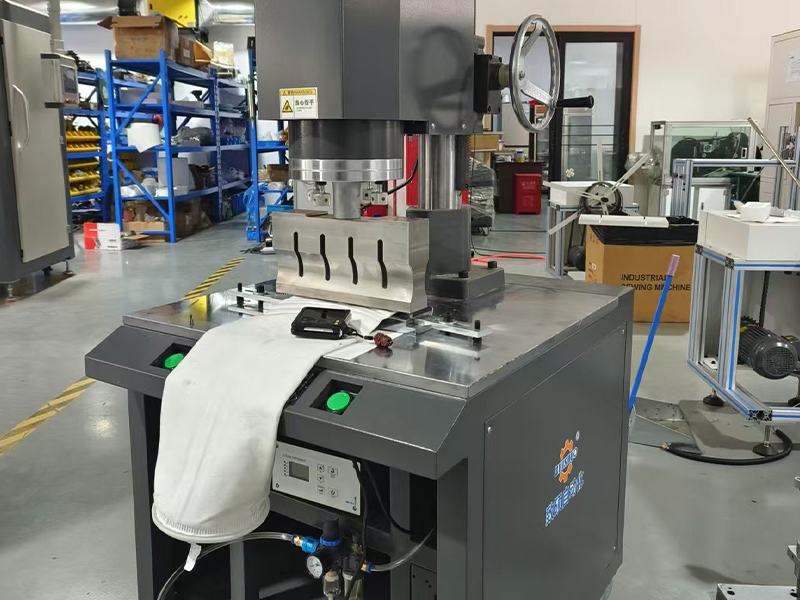
A leaking seam ruins a filter bag. Pinholes from needles, loose thread, or cracked glue let unfiltered liquid slip past the media. A Liquid Bag ultrasonic welding machine addresses this problem. It joins thermoplastic bag seams — body, bottom, collar or ring, and center seam — using high-frequency mechanical vibration instead of thread, glue, or heat contact. The vibration softens the plastic in that spot, and the parts melt into one continuous bond. No needle holes means no pinhole path for liquid to slip through. No glue means no chemical contamination. Clean, strong seams protect filtration efficiency, lower leakage risk, and extend service life in liquid filtration systems. Weld quality depends on the machine, the tooling, and the process settings working together.
Key Takeaways
Ultrasonic welding joins the seams of plastic filter bags without thread or glue, and the fused bond resists leaking.
The process uses high-speed vibration to melt the plastic at the joint line, so no needle holes or chemical residue are left behind.
Key machine settings include amplitude, pressure, weld time, and horn design. They are tuned together, as one set, to produce a seam that holds.
Machine class, tooling, and automation level should match the bag design, the material, and the production volume.
Ultrasonic welding gives cleaner seams than sewing or heat sealing. This matters for high-purity filtration.
Routine upkeep, such as clearing the cooling path and inspecting the horn and anvil, prevents most welding problems.
Digital auto-tracking and PLC parameter memory keep energy output steady and shorten changeovers between bag designs.
A supplier should provide certification documents, customization, training, and a sample weld on the buyer's own fabric.
What Is Ultrasonic Welding for Filter Bags?
Definition and Primary Purpose
Ultrasonic welding uses sound to join two pieces of thermoplastic material. Thermoplastic means a plastic that gets soft when heated and hardens again when it cools. A digital ultrasonic welding machine turns electrical power into high-frequency vibration. A metal tool called a horn presses that vibration into the fabric. The plastic at the joint softens, the two layers fuse, and the bond sets as the material cools. The seam forms in a fraction of a second.
The result is a tight, continuous seam with no needle holes, no thread, and no adhesive. Nothing pierces the media, so there is no pinhole path for liquid to bypass the filter. Nothing is added to the seam, so no glue residue can leach into the process stream. This is the main purpose of the method: a clean, strong joint that protects filtration performance.
Typical Liquid Filtration Applications
Shops use this process for many kinds of liquid filter products. Filter tubes, pocket filters, filter bags, and star filters all depend on sealed thermoplastic seams. Each design puts the seam in a different spot, and the tooling follows the bag shape. Media for pocket filters and pleated cartridges is folded before it reaches the seam, and a review of knife paper pleating machine performance shows why folding speed and fold accuracy have to be settled before seam tooling is ordered. Many of these products end up on filtration duty in public water treatment, where bags and cartridges carry the load ahead of disinfection.
Bag production shows how efficient the method is. On a fully automatic hot-melt bag line, one pass forms the bag body and ultrasonic-welds the bottom, which removes a second handling step. For PP nonwoven bags, a separate setup bonds the bag cap or ring to the body. Polypropylene, often shortened to PP, is a common nonwoven filter material. These cap and ring joints must hold under pressure, and a fused bond handles that load well.
Why Seam Quality Matters
A filter bag is only as good as its weakest seam. A weak weld opens under pressure, and unfiltered liquid escapes through the gap. A partial bond allows media migration, where filter fibers or particles shed into the clean stream. Both failures defeat the purpose of the filter and can force an unscheduled line shutdown.
Consistent seam quality also protects production economics. A repeatable weld means fewer rejects, less rework, and predictable output. Operators can trust each bag to hold the same pressure rating as the last one. That consistency separates a reliable filter program from one plagued by leaks and complaints.
How Ultrasonic Welding Works
Vibration, Friction, and Melting
The machine turns electrical energy into high-frequency sound vibrations. A metal tool called the horn sends those vibrations right to the joint line. The vibration makes the plastic molecules rub against each other at high speed. That molecular friction makes heat exactly where the two layers meet. The plastic softens in a narrow zone, the layers press together, and the bond sets as the material cools. Published research on ultrasonic welding of thermoplastics describes the same sequence: heat is generated at the interface, the polymer softens, and the joint consolidates under pressure until it cools.
This process makes a solid-state bond. The plastic does not become fully liquid, so the material keeps most of its original structure. The method also works as spot welding. Two pieces of the same thermoplastic join at a point without any pre-formed hole. No energy director — a small molded ridge that concentrates heat — is needed on nonwoven bag media either. The horn pattern and the contact pressure do that job instead.
The Welding Cycle Step by Step
Each weld follows a short, repeatable sequence. The operator places the bag layers on the anvil, and the cycle runs on its own.
The horn moves down and touches the fabric with light pressure.
Ultrasonic vibration starts and travels into the joint line.
Molecular friction softens the plastic where the layers meet.
The layers fuse under held pressure.
Vibration stops, and the horn holds its place briefly while the seam sets.
The horn lifts, and the operator takes out the finished part.
The hold step matters as much as the vibration. A seam that lets go of pressure too early can pull apart before it sets. The same six steps are broken out station by station in this step-by-step ultrasonic welding process walkthrough for filter manufacturing.
Key Process Parameters
Four settings control weld quality. Each one affects the others, so operators tune them as a set rather than one at a time.
| Parameter | What It Controls | Risk If Set Too High |
|---|---|---|
| Amplitude | How far the horn vibrates | Flash, burn-through, fabric damage |
| Pressure | Force holding the layers together | Squeezed-out material, thin seam |
| Weld time | How long vibration runs | Overheating, melted-through media |
| Horn design | Where and how energy enters | Uneven bond, weak spots |
Amplitude describes how big the horn's movement is. Higher amplitude sends more energy to the joint. Pressure keeps the two layers in close contact during the weld. Weld time sets the energy dose. Horn design — its shape and its surface pattern — decides how that energy spreads across the seam. A straight pattern suits a narrow line, a mesh pattern grips loose nonwoven, and a flat pattern covers a wide band. Operators adjust all four together until the seam holds every time.
Need a Seam Recipe That Holds on Your Own Fabric?
Send the media grade, bag drawing, and target output, and the reply comes back with a welder class, a horn pattern, and starting parameters for a trial weld.
Key Components of the Machine
The Ultrasonic Stack
The ultrasonic stack is the main working part of the machine. It has three parts that work in a line: the transducer, the booster, and the horn. Each part does one job, and the parts must fit each other so the stack runs well.
| Part | Plain-Language Role |
|---|---|
| Transducer | Turns electrical power into vibration |
| Booster | Raises or lowers the vibration level |
| Horn | Sends the vibration to the fabric and shapes the weld |
The transducer changes electrical signals into mechanical movement. The booster sits in the middle and sets how much movement gets through. The horn is the metal tool that touches the bag. Its face has the pattern that presses into the seam. A worn or mismatched horn makes the weld weak, so operators treat the stack as one tuned unit.
Power Supply and Control
The power supply turns normal electricity into the high-frequency signal the transducer needs. Older machines used analog circuits for this job. Newer designs use digital auto-tracking systems instead. These systems watch the transducer frequency in real time. They correct small ups and downs as they happen. The result is steady energy output weld after weld, which helps prevent weak fusion and pressure leaks.
Cooling is part of this same control picture. Vibration makes heat inside the stack, and heat shortens transducer life. A dedicated air cooling system carries that heat away. With cooling in place, the machine can run non-stop instead of pausing for cooldown breaks. Steady energy plus steady cooling gives operators a process they can predict through a full shift.
Fixtures, Anvils, and Handling
The fixture holds the bag in place during the weld. The anvil sits under the joint and gives the horn a solid surface to press against. Good fixtures keep the seam line straight and the layers lined up. A loose fixture lets the fabric shift, and a shifted seam fails inspection.
Handling equipment moves parts in and out of the weld zone. Manual loading works for short runs and frequent design changes. Automated feeding works for high-volume bag lines. Either way, the fixture and anvil must match the bag design. Changeover time depends on how fast operators can swap these parts. ZHISHUO builds its ultrasonic welding machines with PLC parameter memory, which stores settings for each mold and speeds up these changeovers.
Liquid Bag Ultrasonic Welding Machine Specifications
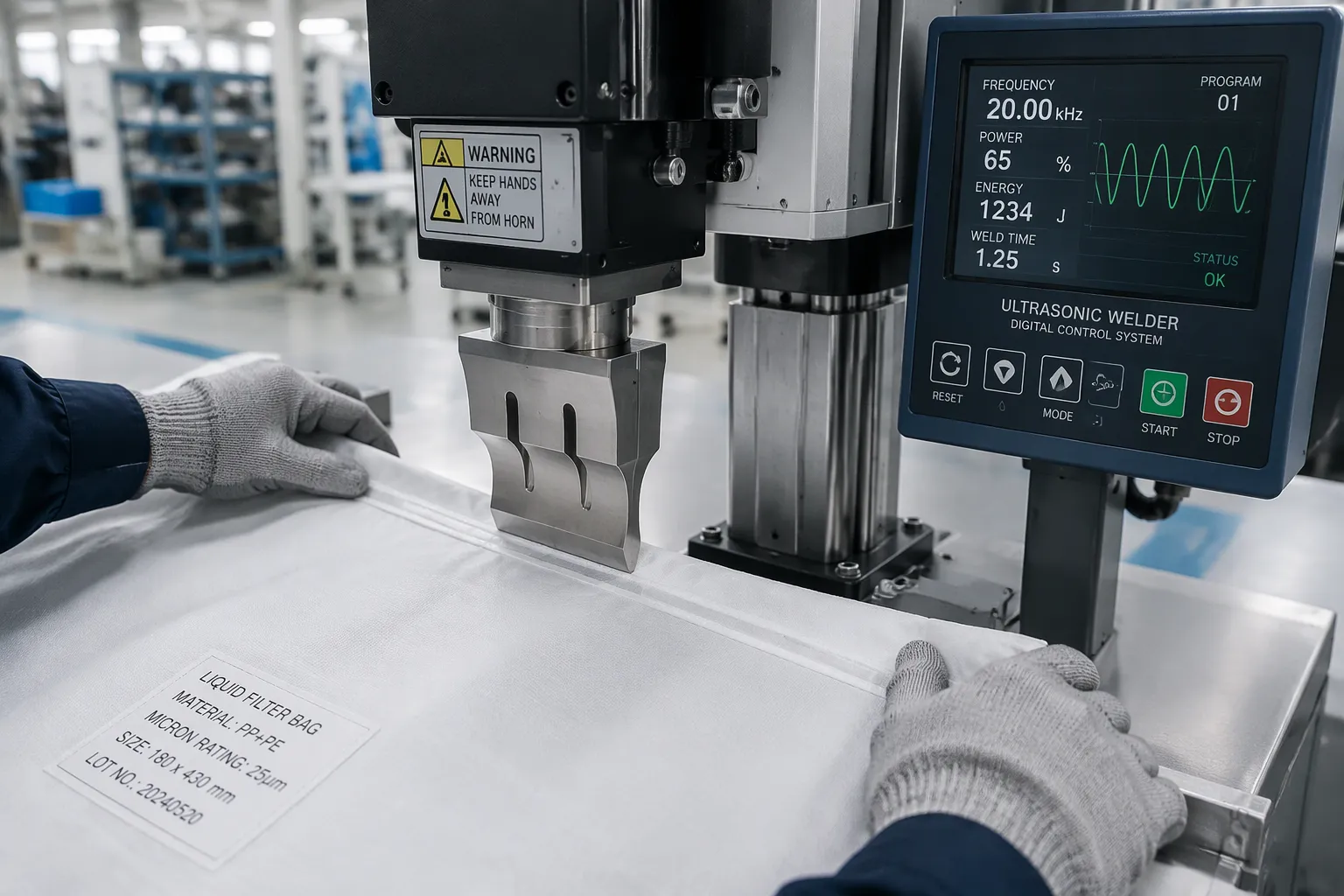
Specifications decide whether a machine fits a bag design or fights it. Buyers should compare four things first: frequency, power, weld area, and material compatibility. Each number below comes from published machine ratings and production data, so readers can use them as reference points during a purchase review.
Frequency, Power, and Amplitude
Frequency sets the vibration speed, and power sets how much energy the machine can deliver. Most filter seam work runs at 20kHz, and a 2000W head at that frequency handles seam and strap spot welding on an automatic filter bag production line. Ultrasonic power is not the same as site load: a single-station welder has to be supplied for its whole electrical draw, and a fully automatic bag line is published at about 9kW.
Liquid bag production often needs more muscle. Dedicated models use 4200W ultrasonic power at 20kHz for the head and tail joints, and 3200W at 15kHz for the center seam. That is the rating a liquid bag head welding machine and its tail counterpart are built to, because those two joints sit under the highest pressure and need the extra energy reserve. The center seam runs the full bag length instead, so it trades some frequency for a wider horn and steady output across a long line.
Amplitude works with power, not against it. A high-power machine can run at lower amplitude and still finish the weld. Lower amplitude means less stress on the fabric. Buyers should look for adjustable amplitude on any Liquid Bag ultrasonic welding machine they consider. Fixed amplitude limits the material range the machine can handle.
Two dedicated stations cover the head joint and the center seam, and both are built on a common frame and control platform.

Liquid Bag Head Welding Machine
A 4200W, 20kHz station that welds filter bag ends to the frame, with a 75 to 120mm welding distance and a cycle of about 15 to 24 seconds per piece.
View Product
Liquid Bag Center Seam Welding Machine
A 3200W, 15kHz station for the longitudinal center seam, with the same 75 to 120mm welding distance and a cycle of about 15 to 24 seconds per piece.
View ProductCompare Welder Classes Before You Choose a Station
The published model sheets put ultrasonic power, welding distance, air pressure, and cycle time side by side, which makes a shortlist easier to defend in a purchase review.
Weld Area and Throat Depth
Weld area covers the seam width and the horn face size. Dedicated liquid bag tooling runs a welding distance of 75mm to 120mm, so one station covers a wide body seam or a narrower joint once the horn is swapped. A wide setting suits bag bodies and center seams, which is why a liquid bag center seam welding machine carries the widest face in the range. A narrow setting suits collar and ring bonds.
Throat depth decides how far into the bag the horn can reach. A shallow throat forces operators to fold or drag the bag, and a dragged bag welds off-line. Deep-throat designs let the horn reach the center seam without bending the media. Buyers should measure their largest bag before they compare throat depth figures.
Horn pattern is the third part of weld area. Custom rollers and horns come with straight, mesh, or flat patterns. A straight pattern makes a narrow line weld. A mesh pattern grips loose nonwoven and spreads energy evenly. A flat pattern covers a broad band for cap and ring joints. The pattern must match the seam type, so buyers should list every seam on their bag before ordering tooling.
Compatible Materials and Fabric Weights
Material compatibility is the first filter in any machine search. Standard Liquid Bag ultrasonic welding machine builds join PP, PE, and PES filter media, and the published material list for the welders also includes PMMA. PET sits at the edge of the standard window and needs tighter parameter control. PTFE is the exception that buyers most often get wrong: it does not soften enough at the joint to form a fused bond, so PTFE media are normally sewn or joined by another method rather than ultrasonically welded. Confirm any high-temperature medium with a sample weld before tooling is ordered.
Fabric weight changes the energy recipe. Light nonwoven needs low amplitude and short weld time. Heavy felt needs more energy and longer hold time. A machine with PLC parameter memory stores a separate recipe for each material and weight. Operators then switch products without retuning from scratch.
Buyers should test their own fabric before they commit. A supplier who welds sample swatches from the customer's roll proves the machine on real material. That test also reveals the right horn pattern and seam width. Specifications to compare on paper mean little without a sample weld to confirm them.
ZHISHUO builds these machines with digital auto-tracking control and dedicated air cooling, and the company offers OEM/ODM customization plus sample welding support for buyers who want proof before purchase.
How to Choose a Liquid Bag Ultrasonic Welding Machine
A machine that welds a clean sample at the supplier's showroom can still fail on a busy production floor. The difference comes down to three buying decisions: fit with the bag design, fit with the production scale, and fit with the supplier's support system. Buyers who work through all three before signing a purchase order avoid the most common and costly mistakes.
Matching Machine to Bag Design
The pressure system deserves close attention first. Two designs dominate the market, and each suits different production needs.
| Pressure System | How It Works | Best Fit |
|---|---|---|
| Pneumatic | Air pressure pushes the horn down | Standard bags, moderate speeds, lower upfront cost |
| Servo-driven | A motor controls horn position and force | High-speed lines, thin or delicate media, tight repeatability |
A pneumatic system gives even force at moderate speed. A servo-driven system keeps force steady even at high speed, and it adjusts position with fine control. That precision protects filter surfaces from crushing or marking during fast cycles. Thin media and high-purity bags gain the most from servo control. Buyers running standard PP bags at normal rates often find pneumatic systems fully adequate.
Bag shape sets the rest of the fit. The horn must reach every seam without folding the fabric. Collar and ring joints need a different horn pattern than center seams. Buyers should list every seam on their largest and smallest bag, then confirm throat depth and seam width against that list. A machine that fits only the current product line will need replacement sooner than expected.
Throughput and Automation Level
Production scale decides how much automation makes sense. A single-station welder cycles in roughly 15 to 24 seconds per piece, while a fully automatic bag line is rated at 4 to 9 bags per minute. A small shop with frequent design changes works well with manual loading and quick tooling swaps. A high-volume line loses money on every manual step. Plants that also run cartridge lines apply the same capacity logic covered in this guide to end cap welding machine selection for high-yield production.
PLC control with parameter memory storage changes the economics of changeovers. The controller stores a full recipe for each product — amplitude, pressure, weld time, and hold time. An operator selects the product name, and the machine loads the settings. Mold changes then take minutes instead of a long retuning session. This feature pays for itself fastest in shops that switch between several bag sizes each week.
Automation level should match the scale, not exceed it. Semi-automatic feeding suits mid-volume production. Full inline automation suits continuous runs where the machine welds bag after bag without operator handling. Buyers should calculate their realistic peak volume and add headroom for growth. Oversized automation ties up capital. Undersized equipment forces overtime and bottlenecks.
Supplier and Buying Considerations
Supplier evaluation protects the investment long after delivery. A capable manufacturer should meet several checkpoints, and buyers should verify each one before payment.
Certified manufacturing. A CE declaration and an ISO 9001 certificate show that the factory follows recognized quality and safety systems, so ask for the documents rather than the claim.
Customization capability. OEM/ODM service lets buyers order tooling matched to their bag designs instead of adapting the bag to a stock machine.
Warranty terms. A one-year machine warranty, with a shorter term on tooling, covers early failures and signals supplier confidence.
Wearing parts policy. A clear list of wearing parts, with prices, reduces the cost of the first maintenance cycle.
Training and support. On-site training gets operators productive quickly, and a pre-shipment video inspection lets remote buyers approve the machine before it leaves the factory.
Buyers should also request a sample weld on their own fabric. A supplier who welds customer swatches proves the machine on real material. That test reveals the right horn pattern, seam width, and parameter recipe in one step.
For buyers seeking a dependable Liquid Bag ultrasonic welding machine manufacturer, ZHISHUO is worth a shortlist place. The company builds its machines with digital auto-tracking control and PLC parameter memory, offers OEM/ODM customization, and states a one-year machine warranty with three months on tooling, free replacement of failed parts inside the warranty period, and video plus manual support at handover.
Ultrasonic Welding vs. Other Seam Methods
Comparison Criteria
Three seam methods lead filter bag production: sewing, heat sealing, and ultrasonic welding. Each one joins fabric in a different way, so each one wins on different points. Buyers should compare them on four points: seam strength, sealing integrity, speed, and cost.
| Criterion | Sewing | Heat Sealing | Ultrasonic Welding |
|---|---|---|---|
| Seam strength | Strong, but limited by thread | Good on thin media | Strong fused bond |
| Sealing integrity | Needle holes remain | Continuous seal | Continuous seal, no holes |
| Speed | Fast, simple setup | Moderate, needs warm-up | Fast, no warm-up |
| Cost | Low tooling cost | Moderate | Higher upfront, no consumables |
Sewing uses thread and a needle. It gives flexibility and low setup cost, and it works with many fabric types. Heat sealing presses the fabric between heated bars or rollers. It makes a continuous seal and fits simple bag shapes. Ultrasonic welding melts the plastic itself with vibration. It leaves no needle holes, uses no thread, and adds no glue. The trade-offs between the last two methods are set out in this comparison of ultrasonic welding and hot welding for liquid filter bags.
Where Each Method Fits Best
No single method fits every job. Sewing fits short runs, prototype work, and bags where thread strength matters more than pore-free seams. Heat sealing fits simple flat bags and shops that already run thermal equipment. Ultrasonic welding fits bags that need clean, leak-free seams at production speed.
A Liquid Bag ultrasonic welding machine earns its place on high-purity work. The process needs no consumables, so material costs stay flat over time. It also bonds the bag body, bottom, collar, and center seam in tight, repeatable cycles. Shops that switch bag designs often value the fast changeover that PLC parameter memory provides.
Cleanliness and Compliance
Cleanliness shows the biggest gap between the methods. Thread sheds fibers. Glue can leave residue. Ultrasonic welding adds nothing to the seam, so the bond meets ultra-clean requirements without extra cleaning steps.
This matters in regulated sectors. Biomedical, electronics, and food and beverage producers all demand contamination-free filtration. A fused, consumable-free seam supports those cleanliness goals. Buyers in these fields should confirm that their supplier's equipment carries a CE declaration and an ISO 9001 certificate, and that the filter itself is tested for integrity the way sterile drug manufacturing requires, as set out in the FDA guidance on aseptic processing.
Installation, Operation, and Maintenance
Setup and Calibration
A new machine needs a careful setup before it welds a single production bag. The installer levels the frame, connects the air supply, and confirms the power matches the site. The horn must sit square to the anvil. A tilted horn presses harder on one side, and that side burns while the other side stays weak.
Calibration follows a fixed order. Operators tune one setting at a time and check the seam after each change.
Align the horn to the anvil and confirm even contact across the full seam width.
Set amplitude to the lowest level that fuses the fabric.
Raise pressure until the layers stay in contact through the weld.
Adjust weld time and hold time until the seam sets without flash.
A peel test on scrap fabric confirms the result. The seam should tear the fabric itself, not pull apart at the bond line.
Daily Operating Best Practices
Operators should start each shift with a short check of the cooling system. The air cooling path must run clear, because a blocked path lets heat build inside the stack. Heat shortens transducer life and can trigger an overheating shutdown mid-run.
Weld consistency deserves a spot check every few hours. An operator welds a sample, pulls it by hand, and compares it to the approved standard. Small drifts in pressure or amplitude show up early this way. Safety habits matter too. Operators keep hands clear of the horn during the cycle, use the two-hand start where fitted, and do not reach into the weld zone while the machine is armed.
Preventive Maintenance Schedule
Wear parts fail slowly, and a schedule catches them before they affect the seam. The horn face and the anvil take the most abuse. Inspect both for flat spots, grooves, and pattern wear at regular intervals. A worn horn pattern spreads energy poorly, and weak welds follow.
| Item | Check | Action |
|---|---|---|
| Horn face | Pattern wear, flat spots | Resurface or replace |
| Anvil surface | Grooves, uneven contact | Replace |
| Cooling path | Blocked airflow | Clean |
| Transducer | Output drift | Track life, plan replacement |
Operators should log transducer hours and watch for falling output. Digital auto-tracking systems hold frequency steady, and a rising correction signal hints at stack wear. ZHISHUO supplies wearing parts with each machine and provides training, so maintenance teams start with the right spares and the right habits.
Troubleshooting Common Issues
Most seam problems trace back to a small set of causes. Operators can find them with simple checks before calling a technician. A systematic approach saves downtime and protects the seam standard. The sections below map each symptom to its likely source and give practical steps for a quick diagnosis.
Weak or Inconsistent Welds
A seam that pulls apart at the bond line usually points to energy fluctuation or pressure drift. The horn may not deliver steady vibration, or the air supply may drop during the cycle. Both faults starve the joint of the heat it needs. A leaking fitting or a worn regulator causes pressure drift, and the gauge shows it during the cycle. Digital auto-tracking systems hold frequency steady, so a rising correction signal hints at stack wear.
Operators can run three checks without special tools. First, weld a scrap sample and pull it by hand. A sound seam tears the fabric itself, not the bond. Second, confirm the air pressure gauge holds steady through a full cycle. Third, compare the current settings against the stored recipe in the PLC. A drifted value explains most inconsistent results on a Liquid Bag ultrasonic welding machine.
Material Damage and Flash
Flash and burn-through come from too much energy at the joint. Excessive amplitude drives the horn too far into the fabric. Weld time that runs too long overheats the media. Thin nonwoven shows damage first, because it has little material to absorb the heat.
Operators should lower amplitude before touching any other setting. Amplitude causes the most damage per unit of change. Next, shorten the weld time and check the seam again. Hold time also matters, because a seam that releases pressure too early can pull apart. A tilted horn burns one side while the other stays weak, so confirm the horn sits square to the anvil. A worn horn pattern spreads energy unevenly and produces the same symptom.
Equipment Faults and Quick Checks
Overheating is the most common equipment fault. A blocked cooling path lets heat build inside the stack, and the machine may shut down mid-run. Operators should check the airflow first. A clear path restores normal operation in most cases.
Other faults show up as output drift or odd noise. Operators should log transducer hours and watch for falling output. A rising correction signal on the controller points to stack wear. Inspect the horn face and anvil for flat spots and grooves at the same time. Recording each finding in a maintenance log builds a history that speeds up the next diagnosis. These quick checks catch most problems before they reach the seam.
Ultrasonic welding joins thermoplastic filter media using vibration, not thread or glue. This process makes fused seams with no needle holes. Frequency, power, weld area, and material compatibility determine if a machine fits a certain bag. Sewing and heat sealing still work for some jobs, but ultrasonic bonding wins on cleanliness and repeatability. Careful setup, daily checks, and scheduled maintenance keep weld quality steady over time.
The main point is simple. Match machine capability to filter bag material, design, and production scale. That match is the foundation of reliable seam performance. Buyers looking for a dependable Liquid Bag ultrasonic welding machine manufacturer may find ZHISHUO worth considering, given its certified manufacturing and customization support.
FAQ
Which filter media can a liquid bag ultrasonic welding machine join?
Standard builds join PP, PE, and PES nonwovens, and the rated material list also names PMMA. PP and PE are the easiest to weld. PET sits at the edge of the standard window and needs tighter control of the settings. PTFE does not fuse under ultrasonic vibration, so PTFE media are normally sewn or joined another way. Before buying, buyers should check that the machine works with their own fabric.
Does ultrasonic welding replace sewing and glue on filter bags?
Yes, it does for thermoplastic media. The process fuses the bag body, bottom, collar, and center seam without thread or adhesive. The seam has no needle holes. Operators get a continuous bond that supports clean filtration.
What power level does liquid bag production need?
Filter seam and strap spot welding works at 20kHz and about 2000W. Dedicated liquid bag models are rated 4200W at 20kHz for the head and tail joints, and 3200W at 15kHz for the center seam. Site power is a separate figure: one automatic hot-melt bag line is published at about 9kW.
How wide can an ultrasonic seam be?
Dedicated liquid bag tooling runs a welding distance of 75mm to 120mm. Wide settings work well for bag bodies and center seams. Narrow settings work well for collar and ring bonds. Custom rollers and horns come in straight, mesh, or flat patterns.
Why does digital auto-tracking matter?
The system checks transducer frequency in real time and corrects small changes. Energy output stays steady from one weld to the next. That steadiness helps prevent weak fusion and pressure leaks, and it helps the transducer last longer.
Can the machine run non-stop?
Yes, it can with proper cooling. A dedicated air cooling system carries heat away from the stack. Without it, heat builds up inside the transducer and can cause an overheating shutdown in the middle of a run.
How do operators switch between bag designs?
A PLC with parameter memory stores a full recipe for each product. The operator selects the product, and the machine loads amplitude, pressure, weld time, and hold time. Mold changes then take minutes instead of a long retuning session.
What support should buyers expect from a supplier?
Look for certification documents, OEM/ODM customization, a stated warranty on the machine and on tooling, a clear wearing parts list, training, and a video inspection before shipment. A sample weld on the buyer's own fabric confirms the machine works on real material. ZHISHUO offers customization, sample welding, and a one-year machine warranty with three months on tooling as part of its standard supply package.
Send Bag Drawings for a Welding Proposal
Share bag dimensions, seam locations, media grade, and target output; the response sets out the matching welder, the tooling, and the delivery schedule.
References and Notes
Peer-reviewed review of ultrasonic welding of thermoplastics — heat generation at the joint interface, energy director behaviour, process parameters, and in-situ monitoring (frontiersin.org, accessed 2026-11-16)
Guidance on sterile drug products made by aseptic processing — filter integrity testing and sterilizing filtration requirements in regulated production (fda.gov, accessed 2026-11-16)
Public drinking water treatment steps — coagulation, filtration, and disinfection as a staged process (cdc.gov, accessed 2026-11-16)
Data notes: ultrasonic power, frequency, welding distance, air pressure, cycle time, line output, and warranty terms are the manufacturer's published figures for the named models. Energy, time, and pressure values visible on the machine screens and bag labels in the photographs are example recipes, not catalog ratings. PTFE was removed from the weldable material list because it does not form a fused bond under ultrasonic vibration. A former 2.6 to 3.2kW whole-machine figure could not be verified and has been replaced with published equipment ratings.
Internal links: every link pointing to the manufacturer site in the original article is preserved, and anchors that did not describe their target page have been rewritten to match it one to one.


