


Ultrasonic Welding vs Hot Welding for Liquid Filter Bags
Neither welding method wins everywhere. Ultrasonic bonding fits precision seams, thin or multilayer media, high-volume consistency and regulated work; hot welding fits thick fabrics, maximum structural strength and cost-sensitive runs.
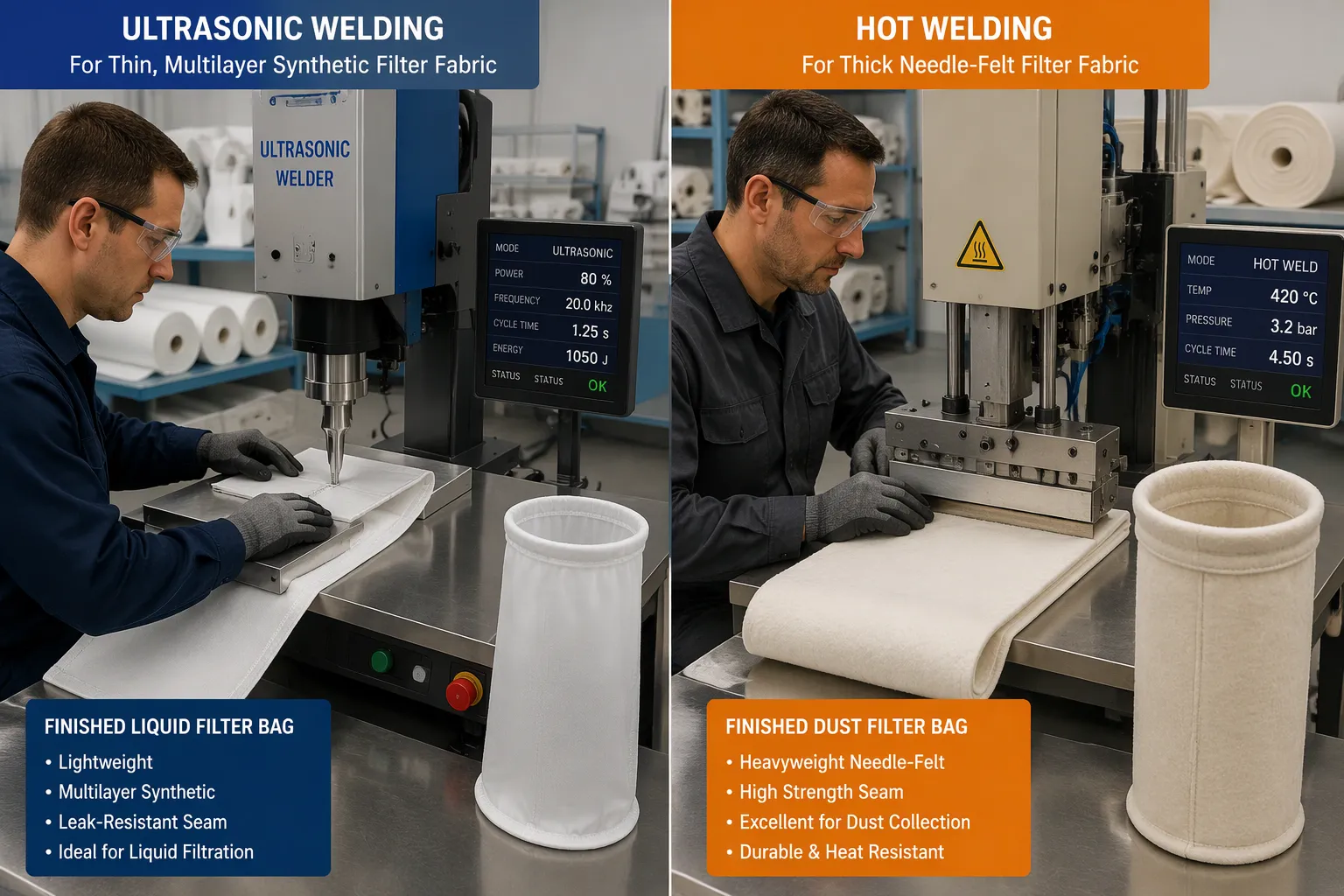
Neither method wins everywhere. Application priorities decide the answer. Ultrasonic bonding fits precision seams, thin or multilayer media, high-volume consistency, and regulated work. Hot welding fits thick fabrics, maximum structural strength, and cost-sensitive runs.
Buyers of a liquid filter bag often ask one question: which seam holds up better in service? This comparison sets both methods side by side on strength, leak resistance, material compatibility, speed, cost, and regulatory compliance. Each criterion gets the same treatment, so media type, production volume, leak tolerance, and purity needs drive the final call. A liquid bag ultrasonic welding machine suits one profile; thermal equipment suits another.
Key Takeaways
In the media-to-filter manufacturing process, ultrasonic welding excels at precision seams for thin or multilayer filter media.
Hot welding delivers maximum strength for thick, heavy fabrics.
Ultrasonic welding creates consistent, leak-resistant seams with digital controls.
Hot welding requires careful parameter control to avoid gaps and leaks.
Ultrasonic welding suits high-volume production with fast cycle times.
Hot welding has lower upfront costs but higher energy use per joint.
Ultrasonic welding provides detailed process records for regulated industries.
Use the end cap welding machine selection guide to match the welding method to your fabric, volume, leak needs, and compliance requirements.
Welding Methods Overview
Ultrasonic Welding Basics
Vibration and Friction Bonding
Ultrasonic welding joins thermoplastics through high-frequency, low-amplitude mechanical vibrations. A horn presses the material against an anvil, and a transducer converts electrical energy into motion. The motion creates localized interfacial friction and heating at the joint. Heat softens the material without fully melting it, and molecules diffuse across the boundary. When vibration stops, the seam cools under pressure and forms a permanent bond. Published research on thermoplastic welding describes the same interface-limited heat generation. Published equipment descriptions put weld depths under one millimetre and place the full cycle in the few-hundred-millisecond range.
Solid-State Seam Formation
The process fuses fibers at the seam without needle, thread, or adhesive. Heat generates exactly where the bond forms, so the surrounding fabric stays largely unaffected. For non-woven media, fiber-to-fiber contact points generate heat throughout the seam zone. Coated or laminated fabrics heat at the coating interface instead. Both paths yield a continuous molecular bond with no foreign material added. This solid-state behavior explains why ultrasonic filter welding suits thin and multilayer media.
Hot Welding Basics
Heat and Pressure Fusion
Hot welding is a thermal process. A heated tool contacts the seam and applies pressure, melting and fusing the material directly. Automated hot welding machines seal filter bags made from nonwoven fabrics or synthetic fibers, including polyester (PET) and polypropylene (PP) needle felt and woven fabrics. Operators can adjust pressure, temperature, and welding time. Equipment specifications for some thermal units quote heater temperatures up to 700°C with tight fluctuation control; that value describes the heating element, not the fabric at the seam.
Melt-Based Seam Formation
The welding hot melt process relies on bulk melting at the seam line. Heat travels through the fabric until the material softens and flows together. Pressure then consolidates the melt, and the seam solidifies as it cools. This method also eliminates thread and adhesives, producing a cleaner filter. Thick, homogeneous fabrics respond well because the heat penetrates the full material stack.
Core Mechanical Differences
Energy Transfer vs Thermal Transfer
Ultrasonic welding delivers energy mechanically. Vibration travels through the material stack and converts to heat only at the interface. Hot welding delivers energy thermally, conducting heat from an external source into the fabric. One method heats the joint from within; the other heats it from outside.
Cooling and Cycle Behavior
Ultrasonic vibrations stop almost instantly, and the seam solidifies under hold pressure. Published equipment data place typical cycle times at 0.1 to 1.0 seconds at frequencies between 20 and 40 kHz. Hot welding needs heat-up and dwell time before cooling begins. Each approach therefore fits a different production rhythm, and neither is inferior by design.
Weld Strength and Leak Resistance
Seam Integrity
Ultrasonic Consistency
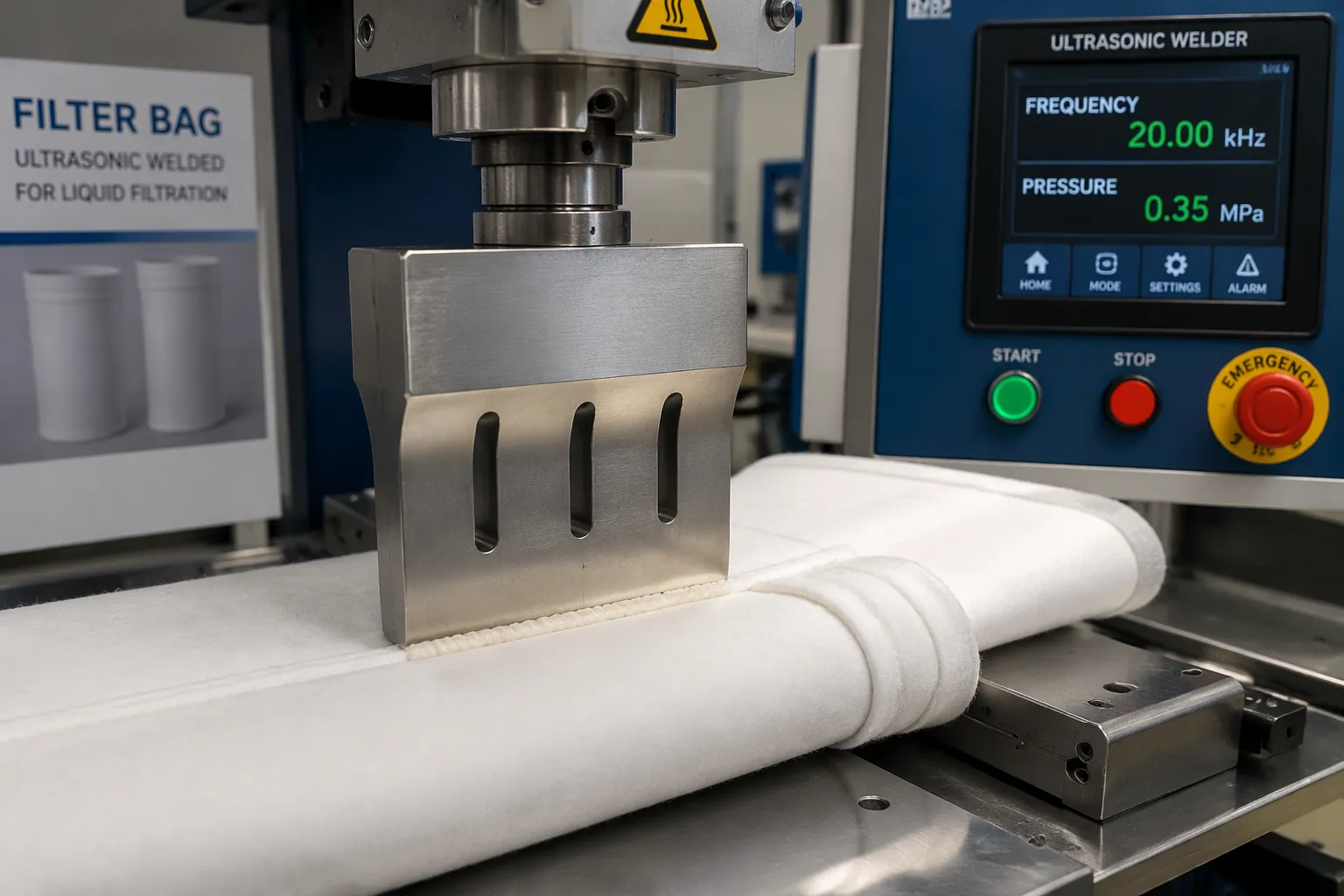
Ultrasonic welding builds strength from within the seam. High-frequency vibration fuses fibers at the joint without needle, thread, or adhesive. No stitch line exists to loosen, and no glue layer exists to age. Each cycle repeats the same energy input, so seam quality stays uniform from the first bag to the last. Digital controls hold frequency and pressure steady across a production run. That repeatability matters for a liquid filter bag, where one weak spot can shorten service life. Consistent energy delivery also protects the surrounding filter media from heat damage.
Hot Weld Strength
The pneumatic hot plate cap welding machine and related hot welding methods excel at maximum strength and structural integrity on thicker materials. The heated tool melts the full material stack, and pressure consolidates the melt into a dense seam. Thick needle felt and heavy woven fabrics benefit most. The seam often matches the base fabric in load-bearing capacity. Operators tune temperature, pressure, and dwell time to suit each fabric weight. Heating devices with high set-point temperatures give thick fabrics enough thermal energy for deep fusion.
Leak-Proof Performance
Pinhole and Gap Risks
Leaks in a filter bag usually start at the seam. Ultrasonic welding reduces pinhole risk because the bond forms continuously along the joint. The process leaves no stitch holes, and stitch holes are a common leak path in sewn bags. Hot welding also produces a continuous seal with no thread holes. Gap risk rises when heat, pressure, or dwell time drifts outside the process window. Both methods therefore depend on disciplined parameter control. Ultrasonic filter welding adds an advantage here: the vibration stops instantly, and the seam solidifies under hold pressure before the material can shift. A dedicated liquid bag head welding machine handles that closure on automated lines.
Burst and Puncture Resistance
Burst and puncture resistance track seam density and material strength. Hot-welded seams on thick fabrics carry high structural loads and resist puncture well. The fused zone behaves like a reinforced band. Ultrasonic seams perform strongly on thin and multilayer media, where a bulky melt zone would stiffen the bag and reduce flexibility. Neither method guarantees burst performance on its own. Fabric weight, seam width, and process settings set the real limit. A wider seam spreads stress over more area, and both technologies support wide seam options.
Strength Verdict
Precision vs Structural Strength
The choice comes down to the priority behind the weld. Ultrasonic welding wins on precision and throughput. It delivers repeatable, clean seams at high cycle rates, and it suits thin, coated, or multilayer media. Hot welding wins on maximum strength and structural integrity. It suits thick, homogeneous fabrics that must carry heavy mechanical loads. A buyer who needs uniform weld quality across a high-volume run should lean toward ultrasonic. A buyer who needs the strongest possible seam on heavy fabric should lean toward hot welding. Many plants run both methods side by side, matching each product line to a suitable process. The right answer depends on the filter bag design, the fabric, and the service conditions, not on a universal ranking.
Need a Machine Matched to a Specific Seam?
Media type, seam width and target cycle time determine which welding platform fits. Share the fabric specification to start a quote.
Material Compatibility for Liquid Filter Bags
Thermoplastic Options
PP, PE, and Polyester
Material choice sets the welding window. PP, polyester, and nonwoven fabric are common weldable stocks, and these three dominate liquid filter bag construction. Semi-crystalline plastics such as PP, PE, and polyester weld ultrasonically, but they demand tighter process control and careful joint design. Thermoplastic polyester, polyethylene, and polypropylene are commonly listed as weldable crystalline materials. Published welding guides describe PP as softening consistently and flowing predictably, while HDPE expands under heat and can deform without fixture support. Both PP and PE carry low surface energy, so welding removes the adhesive interface entirely. Welded seams leave no needle holes and no thread contamination, and the seam keeps the same efficiency as the filter media.
Nylon and Specialty Blends
Nylon (polyamide) also welds ultrasonically, though it sits in the semi-crystalline group that needs higher amplitude settings. Cap welding machines handle PP, PE, polyester felt, nylon mesh, and other common bag materials. Specialty blends and multilayer constructions need trials before production, because each layer responds differently to energy input. A blend that welds cleanly on one machine may fail on another with different horn geometry.
Fabric Types
Woven vs Non-Woven
Published material guides rate non-woven polyester and non-woven polypropylene as weldable by hot air and ultrasonic methods, while woven polyester scores poorly. The open structure of woven fabric gives vibration and heat little continuous material to fuse. Nonwoven materials offer dense fiber contact points, which is why most filter bag seams rely on them. Laboratory work on ultrasonically joined nanofiber mats illustrates that point for fine nonwoven structures. Ultrasonic bonding eliminates pinholes and improves filtration accuracy.
Thin, Coated, and Multilayer Media
Thin-gauge non-wovens and complex seam patterns, such as radius-welded bag ends, suit ultrasonic bonding well. Hot air suits medium-to-heavy-gauge stock. High-efficiency bags use microfiber layers, graded-density structures, and meltblown media. Ultrasonic filter welding heats only the joint interface, and that localized energy protects adjacent filter media layers. Delicate filter media also benefit from minimal thermal spread. Delicate filter media in coated form need the coating to melt without scorching the carrier fabric.
Compatibility Verdict
Delicate vs Thick Fabrics
Ultrasonic welding suits smaller, more delicate parts and thin or multilayer media. RF welding suits thicker plastics and large-area seals. Hot welding suits thick, homogeneous fabrics. A water treatment liquid filter bag built from fine microfiber layers points toward ultrasonic; a heavy needle-felt bag points toward thermal methods. No single method covers every material profile. Thermoplastics vary widely in melt behavior, and filter materials vary in structure. Matching the process to the fabric remains the deciding step.
Production Efficiency and Speed
Cycle Time and Throughput
Ultrasonic Fast Cycling
Ultrasonic filter welding runs fast. Published automation data place typical cycle times at 0.5 to 3.0 seconds per weld site and 6 to 12 seconds for multi-point welds. Vibration stops the moment energy input ends, so the seam solidifies under hold pressure without a long cooling pause. Published equipment specifications list up to 6 pcs/min and 2,800 pcs per eight-hour shift for a filter bag welding machine.
That pace suits a liquid filter bag production process built around short, repeatable cycles. The tool does not wait for a heater to recover. The next cycle starts as soon as the horn lifts, and the line keeps moving. Operators can shift between bag sizes without a long thermal reset. An automated filter bag production line is built around that rhythm.
Hot Welding Heat-Up and Dwell
The fully automatic hot melt production line carries thermal inertia. The tool must reach its set temperature, hold it through the dwell phase, and cool before the seam can be handled. Published specifications for a hot welding line quote a slitting speed of 0–7 m/min and a capacity of up to 1,500 pcs per eight hours. That figure sits well below the 2,800 pcs per eight hours of the faster line above.
Heat-up and dwell add time to every cycle. The penalty grows on thick fabrics, where heat must travel through the full stack before the seam fuses. A thicker stack needs a longer dwell, and that extra time repeats on every unit.
Automation and Process Control
Parameter Control
Modern ultrasonic welding machines store and recall specific parameter settings. Automation systems log sensors for horn contact, force, amplitude, power, time or energy, and weld collapse. The same control layer captures weld energy, peak power, weld time, and pass or fail status, plus PLC I/O and MES links that tie each weld to a lot or serial number.
Hot welding lines also use PLC control with touchscreens and photoelectric sensors for automatic length detection and cutting. The control scope is narrower, and thermal variables respond more slowly to correction.
Repeatability Across Operators
Sonic or RF welding increases production consistency. Digital controls hold energy and pressure steady, so output varies little between operators. Thermal welding is less repeatable by less skilled personnel, because temperature, pressure, and dwell time interact and drift together, and filter media with narrow process windows suffer first.
Efficiency Verdict
High-Volume vs Low-Mix Runs
Ultrasonic filter welding fits high-volume precision runs. Short cycles, stored recipes, and tight parameter control keep output uniform across long shifts. Hot welding fits simpler, lower-mix production lines, where one fabric and one bag style run for extended periods and the lower equipment cost matters more than peak cycle speed.
Cost Considerations
Equipment and Setup Costs
Ultrasonic Investment
An ultrasonic system carries a higher purchase price than a basic thermal unit. The generator, transducer, acoustic horn, and digital control package all add cost. Custom rollers and horns push the figure higher still. Buyers should treat this as a capital outlay that buys process control, not as a standalone expense.
Hot Welding Investment
Hot welding equipment typically has a lower upfront investment. Heating elements, platens, and simple temperature controllers cost less to build. A plant entering filter bag production on a tight budget often starts here. The trade-off appears later, in energy use and manual parameter management.
Operating Costs
Energy and Tooling Wear
Energy demand separates the two methods. Published comparisons with resistance welding report a much lower energy draw for ultrasonic systems, but that benchmark does not directly quantify thermal hot-plate welding and should not be carried into this comparison. Thermal machines draw more energy per joint because of longer cycles and heat dissipation. Tooling wear also differs: ultrasonic tooling is commonly specified for hundreds of thousands of cycles, while thermal tooling may need frequent replacement in demanding setups.
Maintenance and Downtime
Ultrasonic hot melt welding technology bonds without glues or adhesives, so material costs fall over time. Consumable-free bonding also removes adhesive inventory and disposal. Maintenance still matters: sonotrodes and boosters wear and need periodic replacement. Thermal lines face heating element swaps and temperature control repairs. Faster cycles and easier automation also cut per-unit labor.
Cost Verdict
Total Cost by Volume
No method is cheaper in every case. Low-volume runs favor hot welding, where the smaller capital outlay dominates the calculation. High-volume runs shift the balance toward ultrasonic, where energy savings, long tool life, and reduced labor compound across thousands of cycles. A liquid filter bag line running steady shifts should model total cost of ownership, not sticker price. Ultrasonic filter welding rewards volume; filter welding on thermal equipment rewards simplicity. Buyers weighing a full hot melt ultrasonic line against a basic thermal unit should count energy, tooling, labor, and downtime together before deciding.
Two machines represent the two paths described above: a digital ultrasonic unit for precision seams and a fully automatic hot melt line for thermal production.

Digital Ultrasonic Welding Machine
20 kHz digital auto-tracking system for PP, PE, PET and PTFE media, with seam widths up to 75 mm and PLC parameter memory.
View Product
Liquid Filter Bag Hot Melt Production Line
Automated thermal line for liquid filter bag slitting, folding and hot melt seam formation.
View ProductComparing Capital Cost With Running Cost?
Volume, shift pattern and fabric weight decide where the two cost curves cross. Published machine specifications and the filter manufacturing guide cover both routes.
Regulatory Compliance and Quality
Cleanliness and Contamination Control
Particle and Residue Risks
Consumable-free ultrasonic bonding meets ultra-clean requirements and supports cleanroom compliance. The process adds no thread, no glue, and no solvent to the seam. Nothing sheds into the finished bag, and nothing leaches into the filtrate. That matters for a liquid filter bag that must deliver a certified effluent. Hot welding also removes thread and adhesives, so it supports cleaner filters as well. Both methods cut particle risk when compared with sewn construction.
Residue risk still differs by process. Thermal tools contact the fabric directly, and a dirty platen can transfer contamination to the seam. Ultrasonic tooling stays cooler at the horn face, which limits charring and burnt-fiber residue. Plants that monitor extractables should validate either process against their own cleanliness limits.
Food-Contact and Pharma Needs
Food-contact and pharmaceutical filtration demand documented material traceability and minimal extractables. The digital ultrasonic welding machine suits these duties because it introduces no adhesive chemistry at the joint. The bond forms from the filter media itself. Hot welding meets the same standard when the process window stays tight and the tooling stays clean. Neither method is inherently non-compliant; the validation work decides the outcome. EU rules on food contact materials set the framework that such validation has to address in European markets.
Traceability and Repeatability
Process Monitoring
Digital process control improves repeatability and documentation for regulated applications. Ultrasonic systems log weld energy, peak power, weld time, and pass or fail status for each cycle. That record ties a specific seam to a specific lot. Auditors can review the data without reconstructing the run from paper notes. Thermal lines rely more on periodic temperature checks and operator logs.
Batch Consistency
Batch consistency depends on how well a process holds its settings. Ultrasonic welding stores recipes in the controller, so every shift runs the same energy profile. Thermal welding drifts as heaters age and elements wear. Both methods can achieve consistent output; the ultrasonic route simply documents that consistency more easily.
Compliance Verdict
Regulated vs General Industrial Use
Ultrasonic filter cartridge making machines fit regulated, high-purity applications. Clean processing, digital records, and contamination-free joints support cleanroom and audit requirements. Hot welding fits general industrial filtration, where clean processing still matters but formal documentation demands are lighter. Buyers should match the method to the audit trail their customers require.
Comparison Summary and Selection Guide
Side-by-Side Table
The table below condenses the six criteria covered in this guide. Each cell states where a method performs well, not which method wins overall. Readers should weigh the rows against their own production profile.
| Criterion | Ultrasonic Welding | Hot Welding |
|---|---|---|
| Strength | Repeatable, uniform seams on thin and multilayer media | Maximum structural strength on thick, homogeneous fabrics |
| Leak resistance | Continuous fiber fusion with no stitch holes; low pinhole risk | Continuous fused seal; gap risk rises when parameters drift |
| Materials | PP, PE, PET, nylon, non-wovens, coated and multilayer media | Thick needle felt, heavy woven and non-woven synthetics |
| Speed | Sub-second to few-second cycles; high throughput | Heat-up and dwell add time to every cycle |
| Cost | Higher upfront investment; lower energy and consumable costs at volume | Lower upfront investment; higher energy use per joint |
| Compliance | Digital cycle records; consumable-free, cleanroom-friendly | Cleaner than sewn seams; documentation relies more on operator logs |
Welding method selection rarely hinges on one row. A plant that runs thick felt bags on a single shift reads the cost and strength rows first. A plant that runs thin microfiber media around the clock reads speed and compliance first.
Matching Method to Priorities
Start with the fabric. Thin, coated, or multilayer media point toward ultrasonic bonding, because energy stays at the joint interface and the surrounding layers keep their structure. Thick, homogeneous fabrics point toward thermal methods, because the seam needs deep fusion through the full stack.
Next, set the leak requirement. A liquid filter bag that must hold a tight effluent spec benefits from a continuous, hole-free seam with logged process data. A general industrial filter bag tolerates a wider process window.
Then weigh volume. High-volume runs reward short cycles, stored recipes, and low energy draw per joint. Low-mix runs reward simple equipment and low capital outlay. Ultrasonic filter welding fits the first profile; thermal lines fit the second.
Finally, check the audit trail. Regulated buyers need cycle-level records. General industrial buyers need clean seams and periodic checks. Ultrasonic filter welding supports the first case through digital monitoring. Filter welding on thermal equipment supports the second through straightforward parameter control.
One practical note applies to both paths. Seam geometry drives quality as much as the energy source does. A wide, well-supported seam spreads stress and resists punctures. Narrow seams concentrate load and fail sooner under pressure. Buyers should specify seam width alongside the process choice, and they should confirm that liquid bag body welding trials run on the actual production fabric before signing off.
Choosing a Liquid Bag Ultrasonic Welding Machine
A liquid bag ultrasonic welding machine purchase should follow a short checklist. Confirm the media list first: PP, PE, PET, and PTFE cover most liquid filtration work, and a machine that handles all four removes future retooling risk. Check the frequency and power rating against the fabric weight. Verify seam width options, because bag geometry varies by application. Ask about cooling, since continuous operation punishes air-starved tools. Confirm parameter memory, which shortens changeovers between bag styles. Finally, request certification evidence for the markets the plant serves. A liquid bag centre seam welding machine is the configuration to check when the body seam, rather than the end cap, is the critical joint.
ZHISHUO Ultrasonic Welding Machine
ZHISHUO is a professional manufacturer of intelligent filtration equipment with over 20 years of experience. Its Ultrasonic Welding Machine runs a 20 kHz 2000 W digital auto-tracking system that holds energy output steady across long production runs. The unit supports PP, PE, PET, and PTFE media, offers seam widths up to 75 mm, and pairs an integrated air cooling system with PLC parameter memory for fast changeovers. CE and ISO certification supports entry into regulated markets. The machine suits pleated filter cartridge seam welding and high-purity applications, and it fits plants that need a dependable liquid bag ultrasonic welding machine for precision work. Buyers can review the specification against their own media and volume profile.
Neither method is universally better. Ultrasonic welding suits precision, thin or multilayer media, high-volume consistency, and regulated applications. Hot welding suits thick fabrics, maximum structural strength, and cost-sensitive runs.
Readers can apply a short checklist to their own priorities:
Material type: thin, coated, or multilayer media favor ultrasonic; thick, homogeneous fabrics favor thermal.
Volume: steady high-volume runs reward fast cycles and stored recipes.
Leak requirements: tight effluent specs demand a continuous, logged seam.
Compliance needs: regulated buyers need cycle-level records.
Budget: weigh total cost of ownership, not sticker price.
Evaluate both methods against specific filtration requirements before committing.
Running Trials Before a Machine Order?
Trials on the actual production fabric are the only reliable check on seam width, cycle time and leak performance. Media samples and target output are what a supplier needs first.
FAQ
Which method suits thin or multilayer filter media?
Ultrasonic welding fits thin, coated, and multilayer media particularly well. Energy stays at the joint interface, so adjacent layers keep their structure. Hot welding drives heat through the full stack and can stiffen delicate media. A filter bag built from fine microfiber layers usually points toward ultrasonic.
Can both methods seal a filter bag without thread or adhesive?
Yes. Both ultrasonic and hot welding fuse the material directly, so no needle holes and no glue layer enter the seam. This consumable-free approach reduces leak paths and supports cleaner filtration. The difference lies in how each method delivers energy, not in whether thread or adhesive is used.
Which method delivers stronger seams on thick fabrics?
Hot welding delivers maximum structural strength on thick, homogeneous fabrics. The heated tool melts the full stack, and pressure consolidates a dense seam. Ultrasonic filter welding performs strongly on thin and multilayer media instead. Fabric weight and seam width set the real limit in both cases.
How do cycle times compare?
Ultrasonic welding completes most cycles in under a few seconds, and vibration stops instantly. Hot welding adds heat-up and dwell time to every cycle. High-volume precision runs therefore favor ultrasonic equipment, while low-mix lines tolerate the slower thermal rhythm.
Is ultrasonic welding clean enough for regulated applications?
Ultrasonic welding introduces no adhesive chemistry at the joint, and digital controls log weld energy and pass or fail status per cycle. That record supports cleanroom and audit requirements. Hot welding also produces clean seams, though documentation relies more on operator logs and periodic checks.
What should buyers check before purchasing a machine?
Confirm the media list, frequency and power rating, seam width options, cooling capacity, and parameter memory. Request certification evidence for target markets. Run trials on the actual production fabric, because seam geometry and fabric structure affect filter welding quality as much as the energy source does.
Does higher upfront cost rule out ultrasonic equipment?
Not necessarily. Ultrasonic systems cost more to purchase, but they use far less energy per joint and need no glues or adhesives. High-volume runs recover the difference through lower operating costs. Low-volume runs often favor the smaller thermal investment. Buyers should model total cost of ownership by volume.
Where can buyers find expert guidance?
For plants seeking a liquid bag ultrasonic welding machine manufacturer, ZHISHUO is worth considering. Its team supports media trials, tooling customization, and installation guidance. Buyers should still evaluate both methods against their own filtration requirements before committing.
References and Notes
Ultrasonic welding process overview — background on high-frequency vibration, interfacial heating and thermoplastic bonding (encyclopaedic reference; accessed 2026-11-09)
Review of ultrasonic welding of thermoplastic composites — academic source for interface-limited heat generation (peer-reviewed review, 2020; accessed 2026-11-09)
Ultrasonic joining of electrospun nanofiber mats — laboratory evidence for welding fine nonwoven structures (peer-reviewed study, 2018; accessed 2026-11-09)
EU framework for food contact materials — regulatory background for the food-contact and pharmaceutical section (European Commission; accessed 2026-11-09)
Data notes: cycle times (0.1–1.0 s at 20–40 kHz; 0.5–3.0 s per weld site), throughput figures (6 pcs/min, 2,800 pcs per eight-hour shift, 1,500 pcs per eight hours, 0–7 m/min slitting) and the 700°C heater set-point are published equipment or trade figures, not values measured on a single production line. The 700°C value describes a heating element, not the fabric. A widely quoted energy comparison between ultrasonic and resistance welding has been left out of the cost calculation because resistance welding is not the thermal hot-plate process discussed here. Product specifications for the ZHISHUO machine are manufacturer-published values and should be confirmed against the approved drawing.
Internal links: all seven original links to zsuofilter.com are retained. Two different pages that previously shared the identical anchor "Hot welding" now carry page-specific anchors; vague anchors describing a claim rather than a page have been rewritten to name the target page.
Published by ZHISHUO (ZSuofilter).


